MCQ
The compound($s$) with $TWO$ lone pairs of electrons on the central atom is(are)
($A$) $\mathrm{BrF}_5$ ($B$) $\mathrm{ClF}_3$ ($C$) $\mathrm{XeF}_4$ ($D$) $\mathrm{SF}_4$
- A$A,C$
- ✓$B,C$
- C$C,D$
- D$B,C,A$
($A$) $\mathrm{BrF}_5$ ($B$) $\mathrm{ClF}_3$ ($C$) $\mathrm{XeF}_4$ ($D$) $\mathrm{SF}_4$
$C$ $XeF_ 4$
$ClF _3$ and $XeF _4$ contain two lone pairs of electrons on the central atom.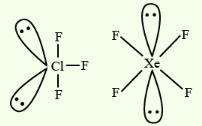
Generate a complete, print-ready paper with questions like this in minutes — across 16+ boards, with answer keys.
$[A]$ With increase in temperature, the value of $K$ for exothermic reaction decreases because entropy change of the system is positive
$[B]$ With increase in temperature, the value of $K$ for endothermic reaction increases because unfavourable change in entropy of the surroundings decreases
$[C]$ With increase in temperature, the value of $K$ for endothermic reaction increases because the entropy change of the system is negative
$[D]$ With increase in temperature, the value of $K$ for exothermic reaction decreases because favourable change in entropy of the surrounding decreases
Reason : trans-Compound in trans addition forms two types of stereoisomers.