MCQ
The compressibility of a material is
  • A
    Product of volume and its pressure
  • B
    The change in pressure per unit change in volume strain
  • The fractional change in volume per unit change in pressure
  • D
    None of the above

Answer

Correct option: C.
The fractional change in volume per unit change in pressure
c
(c)$\frac{1}{K} = $compressibility $ = \left( {\frac{{ - \Delta V/V}}{{\Delta P}}} \right)$

Need a full question paper?

Generate a complete, print-ready paper with questions like this in minutes — across 16+ boards, with answer keys.
Start Generating Free

Similar questions

At what speed should a source of sound move so that stationary observer finds the apparent frequency equal to half of the original frequency
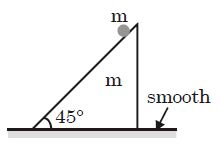
A ball of mass $'m'$ is released from the top of a smooth movable wedge of mass $'m'.$ When the ball collides with the floor,velocity of the wedge is $'v'.$ Then the maximum height attained by the ball after an elastic collision with the floor is :(Neglect any edge at the lower end of the wedge).
A point source emits sound equally in all directions in a non-absorbing medium, Two points $P$ and $Q $ are at distance of $2m$ and $3m$ respectively from the source. The ratio of the intensities of the waves at $P$ and $ Q$ is
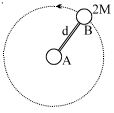
The dumbell is placed on a frictionless horizontal table. Sphere $A$ is attached to a frictionless pivot so that $B$ can be made to rotate about $A$ with constant angular velocity. If $B$ makes one revolution in period $P$, the tension in the rod is
If the dimensions of length are expressed as ${G^x}{c^y}{h^z}$; where $G,\,c$ and $h$ are the universal gravitational constant, speed of light and Planck's constant respectively, then
The horizontal acceleration that should be given to a smooth inclined plane of angle $sin^{-1}\, (1/l)$ to keep an object stationary on the plane relative to the inclined plane is
The change in potential energy, when a body of mass m is raised to a height nR from earth's surface is (R = radius of earth):
A block of metal is heated to a temperature much higher than the room temperature and allowed to cool in a room free from air currents. Which of the following curves correctly represents the rate of cooling
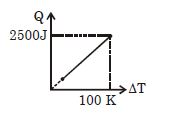
One mole of a gas mixture is heated under constant pressure, and heat supplied $Q$ is plotted against temperature difference acquired. Find the approximate value of $\gamma $ for mixture
The kinetic energy force on the particle continuously increases with time.
  1. The resultant force on the particle must be parallel to the velocity at all instants.
  2. The resultant force on the particle must be at an angle less than 90° all the time.
  3. Its height above the ground level must continuously decrease.
  4. The magnitude of its linear momentum is increasing continuously.