MCQ
The conclusion of Bernoulli's theorem is:
  • A
    Pascal's law
  • Torricelli's theorem
  • C
    Hooke's law
  • D
    Stokes' law

Answer

Correct option: B.
Torricelli's theorem
B

Need a full question paper?

Generate a complete, print-ready paper with questions like this in minutes — across 16+ boards, with answer keys.

Start Generating Free

Similar questions

Three photons coming from excited atomic-hydrogen sample are picked up. Their energies are 12.1eV, 10.2 eV and 1.9eV. These photons must come from:
A passenger inside a bus moving with uniform speed suddenly finds that a ball at rest, starts moving towards his left. It means that the bus now is
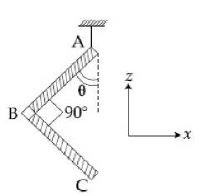
An $L-$ shaped object, made of thin rods of uniform mass density, is suspended with a string as shown in figure. If $AB = BC$, and the angle made by $AB$ with downward vertical is $\theta$ then
$Assertion :$ The root mean square and most probable speeds of the molecules in a gas are the same.
$Reason :$ The Maxwell distribution for the speed of molecules in a gas in symmetrical.
A tunnel is dug along the diameter of earth of mass $'M'$ and then a mass $'m'$ is released a distance $'X'$ from centre so that the time period of oscillation is $T$ . If mass $'4m'$ is released from same point then time period of oscillation will be 
A calorimeter contains $0.2\, kg$ of water at $30\,^oC$, $0.1\,kg$ of water at $60\,^oC$ is added to it, the mixture is well stirred and the resulting temperature is found to be $35\,^oC$. The thermal capacity of calorimeter is .......... $J/K$
The mass per unit length of a uniform wire is $0.135\, g / cm$. A transverse wave of the form $y =-0.21 \sin ( x +30 t )$ is produced in it, where $x$ is in meter and $t$ is in second. Then, the expected value of tension in the wire is $x \times 10^{-2} N$. Value of $x$ is . (Round-off to the nearest integer)
An $\text{AND}$ gate can be prepared by repetitive use of:
  1. $\text{NOT}$ gate.
  2. $\text{OR}$ gate.
  3. $\text{NAND}$ gate.
  4. $\text{NOR}$ gate.
A long cylindrical vessel is half filled with a liquid. When the vessel is rotated about its own vertical axis, the liquid rises up near the wall. If the radius of vessel is $5\,cm$ and its rotational speed is $2$ rotations per second, then the difference in the heights between the centre and the sides, in $cm,$ will be
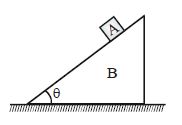
In the figure shown, $A$ & $B$ are free to move. All the surfaces are smooth. then $(0 < \theta < 90^o)$