MCQ
The constant $k$ in Coulomb's law depends upon:
  • Nature of medium
  • B
    System of units
  • C
    Intensity of charge
  • D
    Both $(a)$ and $(b)$

Answer

Correct option: A.
Nature of medium

The value of $\text{K}=\frac{1}{4\pi\in_0}=8.854\times10^{-12}\text{C}^2\text{N}^{-1}\text{m}^{-2}$
Where $ε0​$ is permittivity of free space.

Need a full question paper?

Generate a complete, print-ready paper with questions like this in minutes — across 16+ boards, with answer keys.
Start Generating Free

Similar questions

A moving coil galvanometer has N number of turns in a coil of effective area A, it carries a current I. The magnetic field B is radial. The torque acting on the coil is
What is the coefficient of mutual inductance when the magnetic flux changes by $2 \times 10^{-2}\,Wb$ and change in current is $0.01\,A$......$ henry$
A photon of energy 3.4 eV is incident on a metal having work function 2 eV. The maximum K.E. of photo-electrons is equal to
Five lumen/watt is the luminous efficiency of a lamp and its luminous intensity is $35$ candela. The power of the lamp is.......$W$
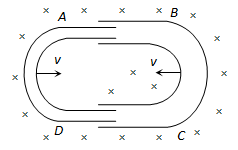
One conducting U tube can slide inside another as shown in figure, maintaining electrical contacts between the tubes. The magnetic field B is perpendicular to the plane of the figure. If each tube moves towards the other at a constant sped v then the emf induced in the circuit in terms of B, l and v where l is the width of each tube, will be
Four ray $1, 2, 3$ and $4$ are incident normally on the face $P Q$ of an isosceles prism $P Q R$ with apex angle $\angle Q=120^{\circ}$. The refractive indices of the material of the prism for the above rays $1,2,3$ and $4$ are $1.85$, $1.95,2.05$ and $2.15$ respectively and the surrounding medium is air. Then, the rays emerging from the face $Q R$ are
In a compound microscope, maximum magnification is obtained when the final image
The cyclotron frequency of an electron gyrating in a magnetic field of $1\, T$ is approximately
For television broadcasting, the frequency employed is normally
A point object is placed at a distance of $10\,cm$ and its real image is formed at a distance of $20\,cm$ from a concave mirror. If the object is moved by $0.1cm$ towards the mirror, the image will shift by about