MCQ
The continuous $X-$ rays spectrum produced by an $X-$ ray machine at constant voltage has
  • A
    A maximum wavelength
  • A minimum wavelength
  • C
    A single wavelength
  • D
    A minimum frequency

Answer

Correct option: B.
A minimum wavelength
b
(b)Continuous spectrum of $X-$ rays consists of radiations of all possible wavelength range having a definite short wavelength limit.

Need a full question paper?

Generate a complete, print-ready paper with questions like this in minutes — across 16+ boards, with answer keys.

Start Generating Free

Similar questions

When a wave travels in a medium, the particle displacements are given by $y = a\, sin\, 2\pi\, (bt -cx)$ where $a, b,$ and $c$ are constants. The maximum particle velocity will be twice the wave velocity if
Nature of meniscus for liquid of ${0^o}$ angle of contact
Two metal strips that constitute a thermostat must necessarily differ in their
Assertion : Ohm's law is applicable for all conducting elements.

Reason : Ohm's law is a fundamental law
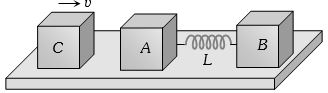
Two blocks $A$ and $B$ each of mass m are connected by a massless spring of natural length L and spring constant $K$. The blocks are initially resting on a smooth horizontal floor with the spring at its natural length as shown in figure. A third identical block $C$ also of mass $m$ moves on the floor with a speed $v$ along the line joining $A$ and $B$ and collides with $A$. Then
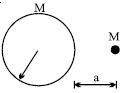
A particle of mass $M$ is at a distance a from surface of a thin spherical shell of equal mass and having radius a.
A charged particle (charge $q$) is moving in a circle of radius $R$ with uniform speed $v.$ The associated magnetic moment $\mu $ is given by
 A force of $(2\hat i - 4\hat j + 2\hat k)$ $N$ acts at a point $(3\hat i + 2\hat j - 4\hat k)$ $metre$ from the origin. The magnitude of torque is  ......... $ N-m$
For a given triode $\mu = 20$. The load resistance is $1.5$ times the anode resistance. The maximum gain will be
The refractive index of a certain glass is $1.5$ for light whose wavelength in vacuum is $6000\;\mathring A.$ The wavelength of this light when it passes through glass is.......$\mathring A$