MCQ
The contribution in the total current flowing through a semiconductor due to electrons and holes are $\frac{3}{4}$ and $\frac{1}{4}$ respectively. If the drift velocity of electrons is $\frac{5}{2}$ times that of holes at this temperature, then the ratio of concentration of electrons and holes is
  • $6 : 5$
  • B
    $5:6$
  • C
    $3 : 2$
  • D
    $2 : 3$

Answer

Correct option: A.
$6 : 5$
a
(a)As we know current density $J = nqv$
==> ${J_e} = {n_e}q{v_e}$ and ${J_h} = {n_h}q{v_h}$
==> $\frac{{{J_e}}}{{{J_h}}} = \frac{{{n_e}}}{{{n_h}}} \times \frac{{{v_e}}}{{{v_h}}}$ ==> $\frac{{3/4}}{{1/4}} = \frac{{{n_e}}}{{{n_h}}} \times \frac{5}{{20}}$ ==> $\frac{{{n_e}}}{{{n_h}}} = \frac{6}{5}$

Need a full question paper?

Generate a complete, print-ready paper with questions like this in minutes — across 16+ boards, with answer keys.

Start Generating Free

Similar questions

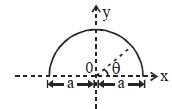
A semicircular ring of radius $'a'$ has charge density $\lambda  = {\lambda _0}\,\cos \,\theta $ where ${\lambda _0}$ is constant and $'\theta'$ is shown in figure. Then total charge on the ring is
Indirect method of charging is:
A star is moving towards the earth with a speed of $4.5 \times 10^6 m / s$. If the true wavelength of a certain line in the spectrum received from the star is $5890 \mathring A$, its apparent wavelength will be about $\left[ c =3 \times 10^8 m / s ^{]}\right.$
If the wavelength of light is 4000 Å, then the number of waves in 1 mm length will be
A circuit to verify $Ohm's$ law uses ammeter and voltmeter in series or parallel connected correctly to the resistor. In the circuit
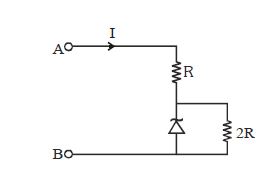
If the voltage between the terminals $A$ and $B$ is $17\ V$ and zener breakdown voltage is $9\ V$ , then the potential voltage across $R$ is.......$V$
Planck constant has the same dimensions as:
If the momentum of an electron is changed by $\Delta P,$ then the de Broglie wavelength associated with it changes by $0.5\%.$ The initial momentum of electron will be
Electronic configuration of germanium is 2, 8, 18 and 4. To make it extrinsic semiconductor small quantity of antimony is added
The $K_{\alpha}\; X-$ray of molybdenum has wavelength $0.071\, {nm}$. If the energy of a molybdenum atoms with a $K$ electron knocked out is $27.5\, {keV}$, the energy of this atom when an $L$ electron is knocked out will be $....\,keV.$

(Round off to the nearest integer) $\left[{h}=4.14 \times 10^{-15} \,{eVs}, {c}=3 \times 10^{8}\, {ms}^{-1}\right.]$