MCQ
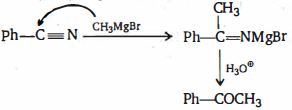
The conversion, $PhCN \to PhCOCH_3,$ can be achieved most conveniently by reaction with
- ✓$CH_3MgBr$ followed by hydrolysis
- B$I_2 - NaOH, CH_3I.$
- Cdil. $H_2SO_4$ followed by reaction with $CH_2N_2$
- D$LAH$ followed by reaction with $CH_3I$
Generate a complete, print-ready paper with questions like this in minutes — across 16+ boards, with answer keys.
$\underset{1}{\mathop{\begin{matrix}
O\,\,\,\,\,\,\,\,\,\,\,\, \\
||\,\,\,\,\,\,\,\,\,\,\,\,\, \\
C{{H}_{3}}COCHC{{H}_{3}} \\
\end{matrix}}}\,$ $\underset{2}{\mathop{\begin{matrix}
\,\,\,\,O \\
\,\,\,\,|| \\
C{{H}_{3}}CCl \\
\end{matrix}}}\,$ $\underset{3}{\mathop{\begin{matrix}
O\,\,\,\,\,\,\,\,\, \\
||\,\,\,\,\,\,\,\,\, \\
C{{H}_{3}}CNHC{{H}_{3}} \\
\end{matrix}}}\,$
$\mathop {\begin{array}{*{20}{c}}
{\begin{array}{*{20}{c}}
{COOH\,\,} \\
{|\,\,\,\,\,\,\,\,\,\,\,\,\,\,\,} \\
{H - C - OH\,\,\,\,\,\,\,\,\,\,\,} \\
{|\,\,\,\,\,\,\,\,\,\,\,\,\,\,\,}
\end{array}} \\
{Br - C - H\,\,\,\,\,\,\,\,\,\,\,\,\,\,\,\,\,} \\
{|\,\,\,\,\,\,\,\,\,\,\,\,\,\,\,\,\,} \\
{\,\,\,COOC{H_3}}
\end{array}}\limits_{(I)} $ $\mathop {\begin{array}{*{20}{c}}
{\begin{array}{*{20}{c}}
{\,\,\,\,\,\,\,\,COOC{H_3}\,\,} \\
{|\,\,\,\,\,\,\,\,\,\,\,\,\,\,\,} \\
{H - C - Br\,\,\,\,\,\,\,\,\,\,\,} \\
{|\,\,\,\,\,\,\,\,\,\,\,\,\,\,\,}
\end{array}} \\
{HO - C - H\,\,\,\,\,\,\,\,\,\,\,\,\,\,\,\,\,} \\
{\,\,|\,\,\,\,\,\,\,\,\,\,\,\,\,\,\,\,\,} \\
{\,\,\,\,\,\,\,COOH\,\,\,\,\,\,\,\,}
\end{array}}\limits_{(II)} $
$2NOB{r_{(g)\,}}\, \rightleftharpoons \,2N{O_{(g)}}\, + \,B{r_{2(g)}}$
if ${P_{B{r_2}}}$ is $\frac {P}{4}$ At equilibrium and $P$ is total pressure then calculate $\frac {P}{K_P}.$