MCQ
The coordination environment of $Ca ^{2+}$ ion in its complex with EDTA ${ }^{4-}$ is :
  • A
    tetrahedral
  • B
    octahedral
  • C
    square planar
  • D
    trigonal prismatic

Answer

[b]
EDTA $^{4-} \rightarrow$ Hexadentate ligand
$
[Ca(\text { EDTA })]^{2-}
$
So Coordination environment is octahedral

Need a full question paper?

Generate a complete, print-ready paper with questions like this in minutes — across 16+ boards, with answer keys.

Start Generating Free

Similar questions

The major product $‘X’$ formed in the following reaction is
Number of $\pi $ bonds in $C{H_2} = CH - CH = CH - C \equiv CH$ is
The vapour density of the methyl ester of an organic monocarboxylic acid is $37$. What is the molecular weight of the acid
Dipole moments of given compound will be
The incorrect statement among the following is
Given that $\frac{1}{3}\mathop {{\lambda _m}}\limits^\infty  \left( {F{e^{3 + }}} \right) = 68\,oh{m^{ - 1}}\,c{m^{ - 1}}\,e{q^{ - 1}}$ and $\frac{1}{2}\mathop {{\lambda _m}}\limits^\infty  \left( {SO_4^{2 - }} \right) = 80\,oh{m^{ - 1}}\,c{m^{ - 1}}\,e{q^{ - 1}}$ What will be value of $\mathop {{\lambda _{eq}}}\limits^\infty  \left( {F{e_2}{{\left( {S{O_4}} \right)}_3}} \right)$ ? ............ ${\rm{oh}}{{\rm{m}}^{ - 1}}{\mkern 1mu} {\rm{c}}{{\rm{m}}^2}$ $\mathrm{eq}^{-1}$
The equilibrium constant of the reaction :

$Cu_{(s)} + 2Ag^+_{(aq)} \rightarrow Cu^{2+}_{(aq)} + 2Ag_{(s)}\,;$

$E^o = 0.46\, V$ at $298\, K$ is
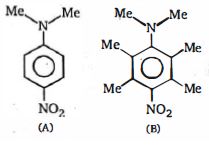
Rank the following compounds in decreasing order of reactivity Electrophilic Aromatic substitution reaction
The enthalpy of combustion of benzene from the following data will be

$(i)$ $6C(s) + 3{H_2}(g) \to {C_6}{H_6}(l);\,\Delta H = + 45.9\,kJ$

$(ii)$ ${H_2}(g) + \frac{1}{2}{O_2}(g) \to {H_2}O(l);\,\Delta H = - 285.9\,kJ$

$(iii)$ $C(s) + {O_2}(g) \to C{O_2}(g);\,\Delta H = - 393.5\,kJ$

........$kJ$

A gas undergoes change from state $A$ to state $B$. In this process, the heat absorbed and work done by the gas is $5\, J$ and $8\, J$, respectively. Now gas is brought back to $A$ by another process during which $3\, J$ of heat is evolved. In this reverse process of $B$ to $A$