MCQ
The correct acidity order of the following is
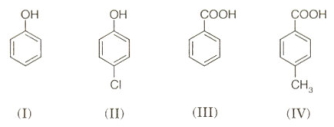
- ✓$(III) > (IV) > (II) > (I)$
- B$(IV) > (III) > (I) > (II)$
- C$(III) > (II) > (I) > (IV)$
- D$(II) > (III) > (IV) > (I)$
Carboxylic acid is more acidic than phenol. When an electron releasing group is present in the para position to $-COOH$ group in aromatic carboxylic acid, the acidity is reduced.
When $Cl$ atom is present in the para position to $-OH$ group in phenol, it increases its acidity.
Here $Cl$ atom withdraws electron density from the ring and stabilizes the phenoxide ion.
Option $A$ is correct.
Generate a complete, print-ready paper with questions like this in minutes — across 16+ boards, with answer keys.
|
LIST $I$ (Compound / Species) |
LIST $II$ (Shape / Geometry) |
| $A$ $\mathrm{SF}_4$ | $I$ Tetrahedral |
| $B$ $\mathrm{BrF}_3$ | $II$ Pyramidal |
| $C$ $\mathrm{BrO}_3^{-}$ | $III$ See saw |
| $D$ $\mathrm{NH}_4^{+}$ | $IV$ Bent $T$-shape |
Choose the correct answer from the options given below :
${image}$
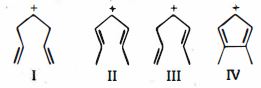
$C_2H_5-Br\overset{AgCN}{\rightarrow}A\overset{H_2/Ni}{\rightarrow}B$
Product $B$ is
$Cr{(OH)_3} + Cl{O^ - } + O{H^ - } \to CrO_4^{2 - } + C{l^ - } + {H_2}O$
$Cr{(OH)_3}$ $-$ $Cl{O^ - }$ - $CrO_4^{2 - }$ $-$ $Cl^-$
The molar mass of the biopolymer is $.....\,\times 10^{4} \,\mathrm{~g}\,\mathrm{~mol}^{-1}$. (Round off to the Nearest Integer)
[Use : $\mathrm{R}=0.083\, \mathrm{~L}\, bar \,\mathrm{mol}^{-1} \,\mathrm{~K}^{-1}$ ]