MCQ
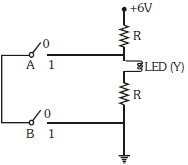
The correct Boolean operation represented by the circuit diagram drawn is
  • A
    $AND$
  • B
    $OR$
  • $NAND$
  • D
    $NOR$

Answer

Correct option: C.
$NAND$
c
$\begin{array}{|c|c|c|}\hline A & {B} & {Y} \\ \hline 0 & {0} & {1} \\ \hline 0 & {1} & {1} \\ \hline 1 & {0} & {1} \\ \hline 1 & {1} & {0} \\ \hline\end{array}$

It is a $NAND$ Gate

Need a full question paper?

Generate a complete, print-ready paper with questions like this in minutes — across 16+ boards, with answer keys.

Start Generating Free

Similar questions

$X-$ rays of which of the following wavelengths are hardest.........$\mathop A\limits^o $
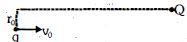
A point chargr $Q$ is fixed A small charge $q$ and mass $m$ is given a velocity $v_0$ from infinity & perpendicular distance $r_0$ as shown. If distance of closest approach is $r_0/2$. The value of $q$ is [Given $mv_0^2 = \frac{{{Q^2}}}{{4\pi { \in _0}\,{r_0}}}$]
Light wave propogates rectilinearly, due to
A bar magnet is oscillating in the earth's magnetic field with time period $T.$ If its mass is increased four times then its time period will be
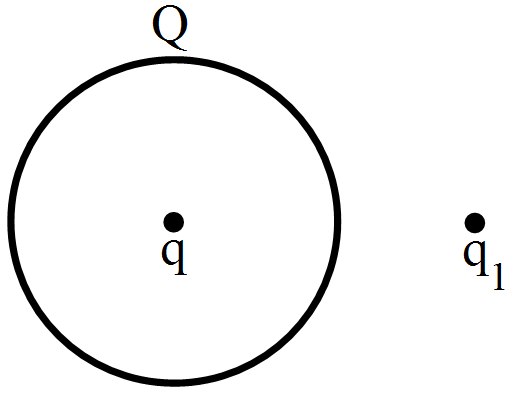
A thin, metallic spherical shell contains a charge $Q$ on it. A point charge q is placed at the centre of the shell and another charge $q_1$ is placed outside it as shown in figure. All the three charges are positive. The force on the charge at the centre is: 
Thermopile is used for
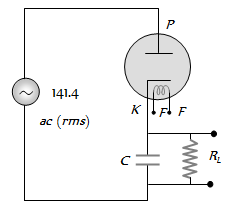
An alternating voltage of 141.4V (rms) is applied to a vacuum diode as shown in the figure. The maximum potential difference across the condenser will be.
An electric motor operating on a 60 V dc supply draws a current of 10 A. If the efficiency of the motor is 50%, the resistance of its winding is
A particle of charge $Q$ and mass $M$ moves in a circular path of radius $R$ in a uniform magnetic field of magnitude $B$. The same particle now moves with the same speed in a circular path of same radius $R$ in the space between the cylindrical electrodes of the cylindrical capacitor. The radius of the inner electrode is $R/2$ while that of the outer electrode is $ 3R/2.$ Then the potential difference between the capacitor electrodes must be
Four identical charges $ + \,50\,\mu C$ each are placed, one at each corner of a square of side $2\,m$. How much external energy is required to bring another charge of $ + \,50\,\mu C$ from infinity to the centre of the square......$J$ $\left( {{\rm{Given}}\frac{{\rm{1}}}{{{\rm{4}}\pi {\varepsilon _{\rm{0}}}}} = 9 \times {{10}^9}\,\frac{{N{m^2}}}{{{C^2}}}} \right)$