MCQ
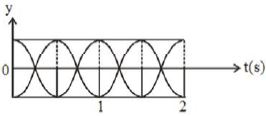
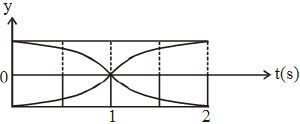
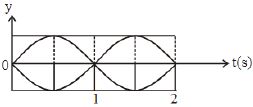
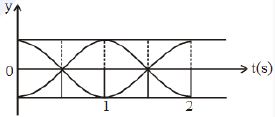
The correct figure that shows, schematically, the wave pattern produced by superposition of two waves of frequencies $9\,Hz$ and $11\,Hz,$

  • B

  • C

  • D

Answer

Correct option: A.

a
. Beat frequency $= |f_1 -f_2| = 11 -9 = 2 \;Hz$

Need a full question paper?

Generate a complete, print-ready paper with questions like this in minutes — across 16+ boards, with answer keys.
Start Generating Free

Similar questions

In order to determine the $e.m.f.$ of a storage battery it was connected in series with a standard cell in a certain circuit and a current $I_1$ was obtained. When the battery is connected to the same circuit opposite to the standard cell a current $I_2$ flow in the external circuit from the positive pole of the storage battery was obtained. What is the $e.m.f$. $\varepsilon_1$ of the storage battery? The $e.m.f$. of the standard cell is $\varepsilon_2$.
Monochromatic light of frequency $6 \times 10^{14} Hz$ is produced by a laser. The power emitted is $2 \times 10^{-3} W$. How many photons per second on an average, are emitted by the source? $\left(\right.$ Given $\left.h =6.63 \times 10^{-34} Js \right)$
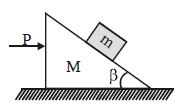
Two wooden blocks are moving on a smooth horizontal surface such that the block of mass $m$ remains stationary with respect to block of mass $M$ as shown in the figure. The magnitude of force $P$ is 
In Young's double slit experiment, the distance between the two slits is $0.1 \,mm$ and the wavelength of light used is $4 \times {10^{ - 7}}m$. If the width of the fringe on the screen is $4\, mm$, the distance between screen and slit is
Three rods each of mass $m$ and length $L$ are joined to form an equilateral triangle as shown in the figure. What is the moment of inertia about an axis passing through the centre of mass of the system and perpendicular to the plane?
In a compound microscope focal length of objective and eyepiece lens is $4\,cm$ and $8\,cm$ respectively. If length of tube is $30\,cm$ then magnifying power for normal adjustment will be
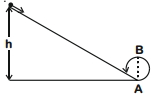
A body initially at rest and sliding along a frictionless track from a height $h$ (as shown in the figure) just completes a vertical circle of diameter $AB =D$ . The height $h$ is equal to 
The potential energy of a particle of mass $4\,kg$ in motion along the $x$-axis is given by $U =4(1-\cos 4 x )\,J$. The time period of the particle for small oscillation $(\sin \theta \simeq \theta)$ is $\left(\frac{\pi}{ K }\right)\,s$. The value of $K$ is .......
$A$ particle of mass m is constrained to move on $x$ -axis. $A$ force $F$ acts on the particle. $F$ always points toward the position labeled $E$. For example, when the particle is to the left of $E, F$ points to the right. The magnitude of $F$ is a constant $F$ except at point $E$ where it is zero. The system is horizontal. $F$ is the net force acting on the particle. The particle is displaced a distance $A$ towards left from the equilibrium position $E$ and released from rest at $t = 0.$ Velocity - time graph of the particle is
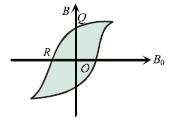
The figure illustrate how $B$, the flux density inside a sample of unmagnetised ferromagnetic material varies with $B_0$, the magnetic flux density in which the sample is kept. For the sample to be suitable for making a permanent magnet