MCQ
The correct increasing order of polarising power is
- A$Ca^{2+} < Mg^{2+} < Be^{2+} < K^{+}$
- B$Mg^{2+} < Be^{2+} < K^{+} < Ca^{2+}$
- C$Be^{2+} < K^{+} < Ca^{2+} < Mg^{2+}$
- ✓$K^{+} < Ca^{2+} < Mg^{2+} < Be^{2+}$
ratio increases and thus polarising power increases. For $B e^{2+}, M g^{2+}, C a^{2+}$, since charge is same and size is in the order of $\mathrm{Ca}^{2+}>M g^{2+}>\mathrm{Be}^{2+}$, the
order of polarising power is $\mathrm{Ca}^{2+}<\mathrm{Mg}^{2+}<\mathrm{Be}^{2+}$
Charge of $K^{+}$ is lowest and size is larger than $\mathrm{Ca}^{2+}$ so its polarising power is lowest.
Generate a complete, print-ready paper with questions like this in minutes — across 16+ boards, with answer keys.
$\underset{(1)}{\mathop{C{{H}_{3}}C{{H}_{2}}CHO}}\,$
$\underset{(2)}{\mathop{\begin{matrix}
O \\
|| \\
C{{H}_{3}}-C-C{{H}_{3}} \\
\end{matrix}}}\,$
$\underset{(3)}{\mathop{C{{H}_{3}}-CH=CH-OH}}\,$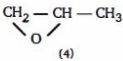
$C{H_3}C{H_2}C{H_2}Br$ $\xrightarrow{{KOH(alc.)}}\,(A)\,\xrightarrow{{HBr}}(B)\,$ $\xrightarrow{{KOH(aq.)}}(C)$ The product $(C)$ is