MCQ
The correct $IUPAC$ name for the below compound is
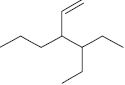
  • $4-$ethyl$-{3-}$propylhex$-1-$ene
  • B
    ${3-}$ethyl${-4}-$ethenylheptane
  • C
    ${3-}$ethyl${-4}-$propylhex${-5}-$ene
  • D
    ${3-}(1-$ethylpropyl$)$hex$-1-$ene.

Answer

Correct option: A.
$4-$ethyl$-{3-}$propylhex$-1-$ene
a
First longest chain carbon is chosen that include alkene with less number according to $IUPAC$ convention.

$4-$ ethyl $-{3-}$ propylhex $-1-$ ene

Need a full question paper?

Generate a complete, print-ready paper with questions like this in minutes — across 16+ boards, with answer keys.

Start Generating Free

Similar questions

The $K_{sp}$ of $Ag_2CrO_4, AgCl, AgBr$ and $AgI$ are respectively, $1.1 \times 10^{-12}, 1.8 \times 10^{-10},$$ 5.0 \times 10^{-13}, 8.3 \times 10^{-17}.$ Which one of the following salts will precipitate last if $AgNO_3$ solution is added to the solution containing equal moles of $NaCl, NaBr, NaI$ and $Na_2CrO_4$ ?
$2\text{NO}_2(\text{g})\rightleftharpoons\text{N}_2\text{O}_4(\text{g})+60.0\text{KJ,}$ the increase in temperature:
Two solutions $A$ and $B$, each of $100\; L$ was made by dissolving $4 \;\mathrm{g}$ of $\mathrm{NaOH}$ and $9.8 \;\mathrm{g}$ of $\mathrm{H}_{2} \mathrm{SO}_{4}$ in water, respectively. The $\mathrm{pH}$ of the resultant solution obtained from mixing $40\; \mathrm{L}$ of solution $A$ and $10\; \mathrm{L}$ of solution $\mathrm{B}$ is
Borax on heating strongly above its melting point melts to a liquid, then solidifies to a transparent mass commonly known as Borax Bead. The transparent glassy mass consists of :
Consider the following statements for diborane 

$1.$  Boron is approximately $sp^3$ hybridized

$2.$  $B-H-B$ angle is $180^o$

$3.$  There are two terminal $B-H$ bonds for each boron atom

$4.$  There are only $12$ bonding electrons available

Of these statements

$KMnO_4$ oxidises oxallic acid to $CO_2$ in acidic medium then equivalent weight of $KMnO_4$ is  $(Mn = 55)$
The amorphous form of silica is
The $p{K_a}$ of acetylsalicylic acid (aspirin) is $3.5$ . The $pH$ of gastric juice in human stomach is about $2-3 $ and the $pH$ in the small intestine is about $8. $ Aspirin will be
When ammonium nitrate is gently heated, an oxide of nitrogen is formed. What is the oxidation state of nitrogen in this oxide?
A minus sign of the free energy change denotes that