MCQ
The correct name of ‘sucrose' is
  • $\alpha - D - {\rm{glucopyranosyl}} - \beta - D - {\rm{fructofuranoside}}$
  • B
    $\beta - D - {\rm{glucopyranosyl}} - \beta - D - {\rm{fructofuranoside}}$
  • C
    $\alpha - D - {\rm{glucopyranosyl}} - \alpha - D - {\rm{fructofuranoside}}$
  • D
    $\beta - D - {\rm{glucopyranosyl}} - \alpha - L - {\rm{fructofuranoside}}$
Answer

Correct option: A.
$\alpha - D - {\rm{glucopyranosyl}} - \beta - D - {\rm{fructofuranoside}}$
a
Sucrose (common name: table sugar, also called saccharose) is a disaccharide (glucose + fructose) with the molecular formula $C _{12} H _{22} O _{11}$.Its systematic name is $\alpha- D$ - glucopyranosyl $11-\beta- D$ - fructofuranoside

Need a full question paper?

Generate a complete, print-ready paper with questions like this in minutes — across 16+ boards, with answer keys.

Start Generating Free

Similar questions

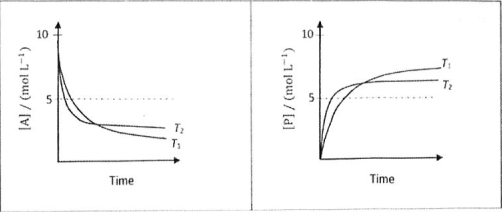
For a reaction, $A \rightleftharpoons P$, the plots of $[ A ]$ and $[ P ]$ with time at temperatures $T _1$ and $T _2$ are given below.

If $T _2> T _1$, the correct statement(s) is (are)

(Assume $\Delta H ^{\ominus}$ and $\Delta S ^{\ominus}$ are independent of temperature and ratio of $\ln K$ at $T _1$ to $\ln K$ at $T_2$ is greater than $T_2 / T_1$. Here $H, S, G$ and $K$ are enthalpy, entropy, Gibbs energy and equillibrium constant, respectively.)

$(A)$ $\Delta H ^{\ominus}<0, \Delta S ^{\ominus}<0$  $(B)$ $\Delta G ^{\ominus}<0, \Delta H ^{\ominus}>0$  $(C)$ $\Delta G ^{\ominus}<0, \Delta S ^{\ominus}<0$  $(D)$ $\Delta G ^{\ominus}<0, \Delta S ^{\ominus}>0$

The pair of compounds having metals in their highest oxidation state is
Principal, azimuthal and magnetic quantum numbers are respectively related to
The successive ionisation energy values for an element $X$ are given below element $X$ belongs to group :-
$A. 1^{st}$ ionisation energy $= 410\, kJ\, mol^{-1}$
$B. 2^{nd}$ ionisation energy $= 820\, kJ\, mol^{-1}$
$C. 3^{rd}$ ionisation energy $= 1100\, kJ\, mol^{-1}$
$D. 4^{th}$ ionisation energy $= 1500\, kJ\, mol^{-1}$
$E. 5^{th}$ ionisation energy $= 3200\, kJ\, mol^{-1}$
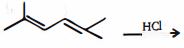
What is the product of $1, 4$ -addition in the reaction shown below ?
A certain electronic transition from an excited state to the ground state of the $H_2$ atom  in one or more steps gives rise to four lines in the ultra violet region of the  spectrum, how many lines does this transition produce in the infrared region of the spectrum :-
Which one of the following arrangements represents the correct order of electron gain enthalpy (with negative sign) of the given atomic species :-
$C{H_3}MgI$ will give methane with
The compound $HCl$  behaves as …. in the reaction, $HCl + HF \to H_2^ + Cl + {F^ - }$
The standard enthalpies of formation of $CO _2( g ), H _2 O ( l )$ and glucose$(s)$ at $25^{\circ} C$ are $-400 \ kJ / mol ,-300 \ kJ / mol$ and $-1300 \ kJ / mol$, respectively. The standard enthalpy of combustion per gram of glucose at $25^{\circ} C$ is