MCQ
The correct order of acidity for the following compounds is
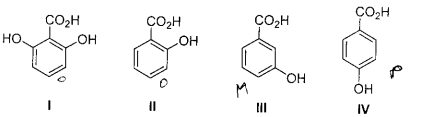
- ✓$I $>$ II $>$ III $>$ IV$
- B$III $>$ I $>$ II $>$ IV$
- C$III $>$ IV $>$ II $>$ I$
- D$I $>$ III $>$ IV $>$ II$
$Image$
Further, $OH$ group has a strong $+ R$ -efect and a weak -$I$-effect. since at m-position $OH$ group cannot exert its $+ R$ -effect but can only exert its -$l$-effect, therefore, $m$-hydroxybenzoic acid $(III)$ is a stronger acid than p-hydroxybenzoic acid $(IV)$ where $OH$ group exerts its strong $+ R$ -effect as shown
$Image$
thus, the overall acid strength decreases in the order:
$\text { 2,6-Dihydroxybenzoic acid (I) }$
$\left(p K_a=4.08\right)$
$ > \text { Salicyclic acid (II) }$
$\left(p K_a=2.98\right)$
$ > \text { m-Hydroxybenzoic acid (III) }$
$\left(p K_a=4.08\right)$
$ > \text { p-Hydroxybenzoic (IV) }$
$\left(p K_a=4.58\right)$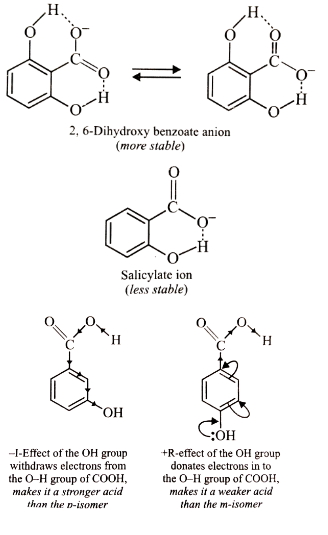
Generate a complete, print-ready paper with questions like this in minutes — across 16+ boards, with answer keys.