MCQ
The correct order of boiling point is
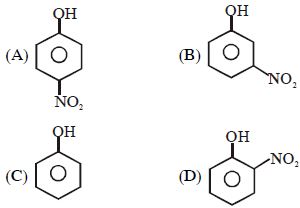
  • A
    $C > A > D > B$
  • B
    $A > B > C > D$
  • C
    $D > A > B > C$
  • $A > B > D > C$

Answer

Correct option: D.
$A > B > D > C$
d

Need a full question paper?

Generate a complete, print-ready paper with questions like this in minutes — across 16+ boards, with answer keys.

Start Generating Free

Similar questions

The strength of an aqueous $NaOH$ solution is most accurately determined by titrating 

(Note : consider that an appropriate indicator is used)

In the given reaction :

$\begin{array}{*{20}{c}}
  O \\ 
  {||} \\ 
  {C{H_3} - C - C{H_3}} 
\end{array}\mathop {\xrightarrow{{Conc.{H_2}S{O_4}}}}\limits_{Distillation} [X]$

$[X]$ will be :

The amount of energy required to break a bond is same as the amount of energy released when the same bond is formed. In gaseous state, the energy required for homolytic cleavage of a bond is called Bond Dissociation Energy ($BDE$) or Bond Strength. BDE is affected by s-character of the bond and the stability of the radicals formed. Shorter bonds are typically stronger bonds. BDEs for some bonds are given below :$ Cl - Cl ( g ) \longrightarrow Cl ^*( g )+ Cl ^*( g ) \Delta H ^{\circ}=58 kcal mol ^{-1}$
$H _3 C - Cl ( g ) \longrightarrow H _3 C ^*( g )+ Cl ^{\circ}( g ) \Delta H ^{\circ}=85 kcal mol ^{-1}$
$H - Cl ( g ) \longrightarrow H ^*( g ) \quad+ Cl ^*( g ) \Delta H ^{\circ}=103 kcal mol ^{-1}$
$(1)$ Correct match of the $C - H$ bonds (shown in bold) in Column $J$ with their BDE in Column $K$ is
Column $J$ Molecule Column $K$ $\operatorname{BDE}( kcal mol -1)$
$(P) \ H - C H \left( CH _3\right)_2$ ${ (i) } 132$
$(Q) \ H - CH _2 Ph$ ${ (ii) } 110$
$(R) \ H - C H = CH _2$ ${ (iii) } 95$
$(S) \ H - C \equiv CH$ ${ (iv) } 88$
$(A) \ P - iii, Q - iv, R - ii, S - i$
$(B) \ P - i, Q - ii, R - iii, S - iv$
$(C) \ P - iii, Q - ii, R - i, S - iv$
$(D) \ P - ii, Q - i, R - iv, S - iii$
($2$) For the following reaction
$CH _4( g )+ Cl _2( g ) \xrightarrow{\text { light }} CH _3 Cl ( g )+ HCl ( g )$
the correct statement is
$(A)$ Initiation step is exothermic with $\Delta H ^{\circ}=-58 kcal mol ^{-1}$
$(B)$ Propagation step involving ${ }^{\circ} CH _3$ formation is exothermic with $\Delta H ^{\circ}=-2 kcal mol ^{-1}$.
$(C)$ Propagation step involving $CH _3 Cl$ formation is endothermic with $\Delta H ^{\circ}=+27 kcal mol ^{-1}$.
$(D)$ The reaction is exothermic with $\Delta H ^{\circ}=-25 kcal mol ^{-1}$.
Isotonic solutions have same
The Lassaigne’s extract is boiled with dil. $HNO_3$ before testing for halogens because
$C_8H_{18}$ ($A$) on mono chlorination forms only one type of $C_8H_{17}Cl\ \  (B)$ Hence ($A$) can be
Which of the following statements are correct?

$A$. Glycerol is purified by vacuum distillation because it decomposes at its normal boiling point.

$B$. Aniline can be purified by steam distillation as aniline is miscible in water.

$C$. Ethanol can be separated from ethanol water mixture by azeotropic distillation because it forms azeotrope.

$D$. An organic compound is pure, if mixed $M.P$. is remained same.

Choose the most appropriate answer from the options given below :

The osmotic pressure of equimolar solutions of $BaCl_2, NaCl$ and glucose at same temperature follow the order
Calculate the number of atoms of oxygen present in $176\, g$ of $CO_2$
If in the reaction ${N_2}{O_4} = 2N{O_2},\,\alpha $ is that part of ${N_2}{O_4}$ which dissociates, then the number of moles at equilibrium will be