MCQ
The correct order of $Cl-O$ bond order is
- A$ClO_3^-< ClO_4^- < ClO_2^-< ClO^-$
- B$ClO^-< ClO_4^-< ClO_3^-< ClO_2^-$
- ✓$ClO^-< ClO_2^-< ClO_3^-< ClO_4^-$
- D$ClO_4^-< ClO_3^-< ClO_2^-< ClO^-$
$ClO_2^-$ $B.O.=1.5$
$ClO_3^-$ $B.O.=1.66$
$ClO_4^-$ $B.O=1.75$
$OR$
$Cl{O^ - } < ClO_2^ - < ClO_3^ - < ClO_4^ - $
$B.O.$ $1.0$ $1.5$ $1.66$ $1.75$
Generate a complete, print-ready paper with questions like this in minutes — across 16+ boards, with answer keys.
$(A) i)$ Lindlar's catalyst, $H _2$; $ii$) $SnCl _2 / HCl$; iii) $NaBH _4$; iv) $H _3 O ^{+}$
$(B) i)$ Lindlar's catalyst, $H _2$; $ii$) $H _3 O ^{+}; iii)$ $SnCl _2 / HCl$; iv) $NaBH _4$
$(C) i)$ $NaBH _4; ii)$ $SnCl _2 / HCl; $iii$)$ $H _3 O ^{+}; iv)$ Lindlar's catalyst, $H _2$
$(D) i)$ Lindlar's catalyst, $H _2$; $ii$) $NaBH _4; iii)$ $SnCl _2 / HCl; iv)$ $H _3 O ^{+}$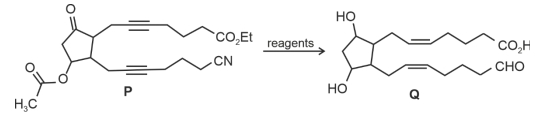
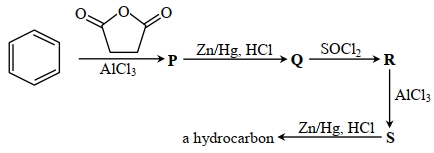
$(A)$ Compounds $P$ and $Q$ are carboxylic acids.
$(B)$ Compound $S$ decolorizes bromine water.
$(C)$ Compounds $P$ and $S$ react with hydroxylamine to give the corresponding oximes.
$(D)$ Compound $R$ reacts with dialkylcadmium to give the corresponding tertiary alcohol.