MCQ
The correct order of $IE_2$ is
- A$Ne > F > O > N$
- B$O > F > Ne > N$
- ✓$Ne > O > F > N$
- D$O > Ne > F > N$
$A ^{+}( g ) \rightarrow A ^{2+}+ e ^{-}$
$IE _2$ is affected by the size, effective nuclear charge and electronic configuration. So, on moving from $N$ to $Ne$ size of ion decreases, thereby increasing the $IE.$
$\rightarrow F ^{+}$is having less $IE _2$ than $O ^{+}$due to the interelectronics repulsion due to its' high electronegativity, it requires comparatively less energy to remove $e ^{-}$from its' outer shell.
Thus, the correct order is: $Ne \,>\, O \,>\, F\, >\, N$
Generate a complete, print-ready paper with questions like this in minutes — across 16+ boards, with answer keys.
$Image$
In this reaction, $\mathrm{RCONHBr}$ is formed from which this reaction has derived its name. Electron donating group at phenyl activates the reaction. Hofmann degradation reaction is an intramolecular reaction.
$1.$ How can the conversion of $(i)$ to $(ii)$ be brought about?
$(A)$ $\mathrm{KBr}$ $(B)$ $\mathrm{KBr}+\mathrm{CH}_3 \mathrm{ONa}$ $(C)$ $\mathrm{KBr}+\mathrm{KOH}$ $(D)$ $\mathrm{Br}_2+\mathrm{KOH}$
$2.$ Which is the rate determining step in Hofmann bromamide degradation?
$(A)$ Formation of $(i)$ $(B)$ Formation of $(ii)$ $(C)$ Formation of $(iii)$ $(D)$ Formation of $(iv)$
$3.$ What are the constituent amines formed when the mixture of $(i)$ and $(ii)$ undergoes Hofmann bromamide degradation?
$Image$
give the answer question $1$, $2$, and $3.$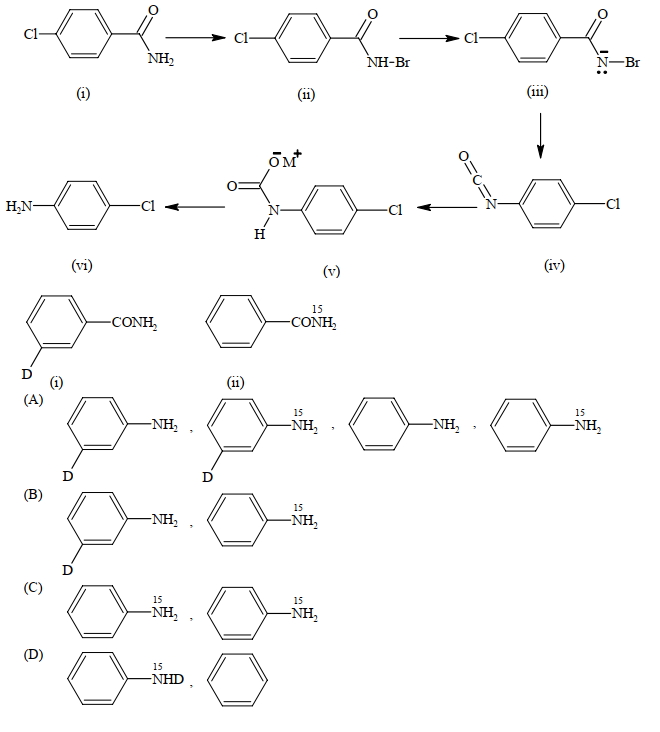

| Exp. No. | [A] | [B] | Rate |
| $1.$ | $1.0$ | $0.15$ | $4.2 × 10^{-6}$ |
| $2.$ | $2.0$ | $0.15$ | $8.4 × 10^{-6}$ |
| $3.$ | $1.0$ | $0.20$ | $5.6 × 10^{-6}$ |
Find out rate law
