MCQ
The correct order of second $I.E. $ of $C, N, O$ and $F$ are in the order
- A$F > O > N > C$
- B$C > N > O > F$
- C$O > N > F > C$
- ✓$O > F > N > C$
${ }_8 O \rightarrow 1 s ^2 \quad 2 s ^2 \quad 2 p ^4$
${ }_9 F \rightarrow 1 s ^2 \quad 2 s ^2 \quad 2 p ^5$
${ }_7 N \rightarrow 1 s ^2 \quad 2 s ^2 \quad 2 p ^3$
${ }_6 C \rightarrow 1 s ^2 \quad 2 s ^2 \quad 2 p ^2$
$2 nd\,\,IE \rightarrow O ^{-} \rightarrow 1 s ^2 \quad 2 s ^2 \quad 2 p ^3$
$F ^{-} \rightarrow 1 s ^2 \quad 2 s ^2 \quad 2 p ^4$
$N ^{-} \rightarrow 1 s ^2 \quad 2 s ^2 \quad 2 p ^2$
$C ^{-} \longrightarrow 1 s ^2 \quad 2 s ^2 \quad 2 p ^1$
Oxygen having half filled configuration is most stable and will require high energy to remove an $e ^{-}$. Followed by fluorine being the most electronegative element, then followed by $N$ which is less electronegative than $F$ but more than $C$.
$\therefore$ Order of second ionization enthalpy is $O\, >\, F\, >\, N\, >\, C$
Generate a complete, print-ready paper with questions like this in minutes — across 16+ boards, with answer keys.
(image)
($A$) $R$ is steam volatile
($B$) $Q$ gives dark violet coloration with $1 \%$ aqueous $FeCl_3$ solution
($C$) $S$ gives yellow precipitate with $2, 4$-dinitrophenylhydrazine
($D$) $S$ gives dark violet coloration with $1 \%$ aqueous $FeCl_3$ solution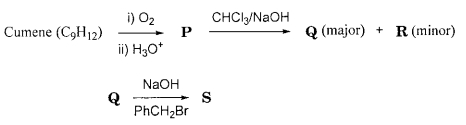
Gas $(A)$ burns with a blue flame and is oxidised to gas $(B)$
Gas $(A) + Cl_2 \to (D)$
$A, B$ and $D$ are