MCQ
The correct order of the basic strength of methyl substitited amines in aqueous solution is:
- A(CH3)2NH > CH3NH2 > (CH3)3N
- B(CH3)3N > CH3NH2 > (CH3)2NH
- C(CH3)3N > (CH3)2NH > CH3NH2
- DCH3NH2 > (CH3)2NH > (CH3)3N
Explanation:
In aqueous solution, electron donating inductive effect, solvation effect (H-bonding) and steric hindrance all together affect basic strength of substituted amines.
Basic character:
$(\text{CH}_3)_2\text{NH}>\text{CH}_3\text{NH}_2>(\text{CH}_3)_3\text{N}\\ \ \ \ \ \ \ \ \ \ 2^\circ\ \ \ \ \ \ \ \ \ \ \ \ \ \ \ \ \ \ 1^\circ\ \ \ \ \ \ \ \ \ \ \ \ \ \ \ \ 3^\circ$
Generate a complete, print-ready paper with questions like this in minutes — across 16+ boards, with answer keys.
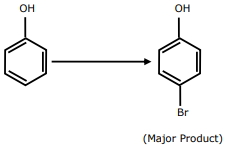
End product $(X)$ of the above reaction is
${\left[\mathrm{V}\left(\mathrm{H}_2 \mathrm{O}\right)_6\right]^{3+}, \quad\left[\mathrm{Cr}\left(\mathrm{H}_2 \mathrm{O}\right)_6\right]^{2+}, \quad\left[\mathrm{Fe}\left(\mathrm{H}_2 \mathrm{O}\right)_6\right]^{3+},}$
${\left[\mathrm{Ni}\left(\mathrm{H}_2 \mathrm{O}\right)_6\right]^{3+},\left[\mathrm{Cu}\left(\mathrm{H}_2 \mathrm{O}\right)_6\right]^{2+}}$
[Given atomic numbers: $\mathrm{V}=23, \mathrm{Cr}=24, \mathrm{Fe}=26$,
$\mathrm{Ni}=28, \mathrm{Cu}=29]$
$(1)$ Bromine water $(2)$ $\mathrm{Br}_{2}$ in $\mathrm{CS}_{2}, 273 \mathrm{~K}$ $(3)$ $\mathrm{Br}_{2} / \mathrm{FeBr}_{3}$ $(4)$ $\mathrm{Br}_{2}$ in $\mathrm{CHCl}_{3}, 273 \,\mathrm{~K}$
Choose the correct answer from the options given below: