MCQ
The correct order of the first ionization enthalpy is
- A$\mathrm{Al}>\mathrm{Ga}>\mathrm{Tl}$
- B$\mathrm{Ga}>\mathrm{Al}>\mathrm{B}$
- C$\mathrm{B}>\mathrm{Al}>\mathrm{Ga}$
- ✓$\mathrm{Tl}>\mathrm{Ga}>\mathrm{Al}$
($ii$) due to scandide contraction Ga has more $I.E$. as compared to $\mathrm{A} \ell$
Generate a complete, print-ready paper with questions like this in minutes — across 16+ boards, with answer keys.
${C{H_3} - C{H_2} - CH = C{H_2} + HBr\,\to \,CH _{3}- CH _{2}- CH _{2}- C^{+}H _{2}+ Br ^{-}} _{"A"}$
${C{H_3} - C{H_2} - CH = C{H_2} + HBr\, \to \,CH _{3}- CH _{2}- C^{+}H - CH _{3}+ Br ^{-}}_{"B"}$
(Image)
$x=$.. . . . . .(nearest integer)
[Given: Molal freezing point depression constant of water at $273.15 \mathrm{~K}^2$ is $1.86 \mathrm{~K} \mathrm{~kg} \mathrm{~mol}^{-1}$ ]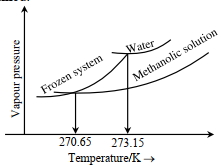
${N_2}{H_4}(l)\,+\,2{H_2}{O_2}(l)\,\, \to \,{N_2}(g)\,\, + \,4{H_2}O(l);\,\,{\Delta _r}H_1^o\, = \, - 818\,\,kJ/mol$
${N_2}{H_4}(l)\,\, + {O_2}(g)\,\, \to \,{N_2}(g)\,\, + \,2{H_2}O(l);\,\,{\Delta _r}H_2^o\, = \, - 622\,\,kJ/mol$
${H_2}(g)\,\, + 1/2{O_2}(g)\,\, \to \,{H_2}O(l);\,\,{\Delta _r}H_3^o\, = \, - 285\,\,kJ/mol$
......$kJ/mol$
Statement $I$: Group $13$ trivalent halides get easily hydrolyzed by water due to their covalent nature.
Statement $II$: $\mathrm{AlCl}_3$ upon hydrolysis in acidified aqueous solution forms octahedral $\left[\mathrm{Al}\left(\mathrm{H}_2 \mathrm{O}\right)_6\right]^{3+}$ ion.
In the light of the above statements, choose the correct answer from the options given below :