Question
The correct relation for a triode is

Answer

The correct relation for a triode is $g _{ m }=\left.\frac{\Delta I _{ p }}{\Delta V _{ g }}\right|_{ V _{ p }=\text { constt. }}$

Need a full question paper?

Generate a complete, print-ready paper with questions like this in minutes — across 16+ boards, with answer keys.
Start Generating Free

Similar questions

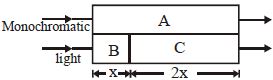
Consider slabs of three media $A, B$ and $C$ arranged as shown in figure. $R.I. $ of $A$ is $1.5$ and that of $C$ is $1.4.$ If the number of waves in $A$ is equal to the number of waves in the combination of $B$ and $C$ then refractive index or $B$ is :-
When $100\, V\, DC$ is applied across a solenoid a current of $1\, A$ flows in it. When $100\, V\, AC$ is applied across the same coil, the current drops to $0.5\, A$. If the frequency of the $AC$ source is $50\,Hz$, the impedance and inductance of the solenoid are:
An electron with kinetic energy $5 \mathrm{eV}$ enters a region of uniform magnetic field of $3 \mu \mathrm{T}$ perpendicular to its direction. An electric field $\mathrm{E}$ is applied perpendicular to the direction of velocity and magnetic field. The value of $\mathrm{E}$, so that electron moves along the same path, is . . . . . $\mathrm{NC}^{-1}$.

(Given, mass of electron $=9 \times 10^{-31} \mathrm{~kg}$, electric charge $=1.6 \times 10^{-19} \mathrm{C}$ )

The angle between two vectors $4\hat i + 3\hat j + \hat k$ and $-3\hat i + 2\hat j + 6\hat k$ is ....... $^o$
In practice, all heat engines have efficiency less than that of a Carnot engine because
Two particles are oscillating along two close parallel straight lines side by side, with the same frequency and amplitudes. They pass each other, moving in opposite directions when their displacement is half of the amplitude. The mean positions of the two particles lie on a straight line perpendicular to the paths of the two particles. The phase difference is
$A$ ray of light is incident at an angle of $75^o$ into a medium having refractive index $\mu$ . The reflected and the refracted rays are found to suffer equal deviations in opposite direction $\mu $ equals
A nucleus at rest splits into two nuclear parts having same density and the radii in the ratio $1 : 2$ . Their velocities are in ratio ———
A frog can be deviated in a magnetic field produced by a current in a vertical solenoid placed below the frog. This is possible because the body of the frog behaves as
Two bodies $M$ and $N $ of equal masses are suspended from two separate massless springs of force constants $k_1$ and $k_2$ respectively. If the two bodies oscillate vertically such that their maximum velocities are equal, the ratio of the amplitude $M$ to that of $N$ is