MCQ
The correct relation is
  • $r = \frac{{2T\,\cos \theta }}{{hdg}}$
  • B
    $r = \frac{{hdg}}{{2T\,\cos \theta }}$
  • C
    $r = \frac{{2T\,dgh}}{{\cos \theta }}$
  • D
    $r = \frac{{T\cos \theta }}{{2hdg}}$

Answer

Correct option: A.
$r = \frac{{2T\,\cos \theta }}{{hdg}}$
a
(a) $h=\frac{2 T \cos \theta}{r d g}$

$r=\frac{2 T \cos \theta}{h d g}$

Need a full question paper?

Generate a complete, print-ready paper with questions like this in minutes — across 16+ boards, with answer keys.
Start Generating Free

Similar questions

A balloon starts rising from ground from rest with an upward acceleration $2 \,m / s ^2$. Just after $1 \,s$, a stone is dropped from it. The time taken by stone to strike the ground is nearly ....... $s$
Two particles of masses $M$ and $4M$ are released from a distance $10\,metres$ from each other. Find the point of collision from smaller particle .............. $\mathrm{metres}$
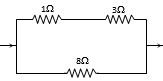
Power dissipated across the $8 \,\,\Omega$ resistor in the circuit shown here is $2\,\, watt.$ The power dissipated in watt units across the $3 \,\,\Omega$ resistor is 
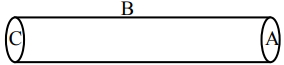
A hollow cylinder has a charge $q$ coulomb within it. If $\phi$ is the electric flux in units of $volt-meter$ associated with the curved surface $B,$ the flux linked with the plane surface $A$ in units of $V-m$ will be
If ${E_0}$ represents the peak value of the voltage in an ac circuit, the r.m.s. value of the voltage will be
A projectile is projected with speed $u$ at an angle $\theta$ with the horizontal. The average velocity of the projectile between the instants it crosses the same level is ............
If the length of a pendulum is made $9$ times and mass of the bob is made $4$ times then the value of time period becomes
A body dropped from a height $h$ with an initial speed zero, strikes the ground with a velocity$3\,km/h$. Another body of same mass is dropped from the same height $h$ with an initial speed of $4\,km/h$ . Find the final velocity of second body with which it strikes the ground.........$km/h$
At which temperature the velocity of $O_2$ molecules will be equal to the velocity of $N_2$ molecules at $0\,^oC$ ....... $^oC$
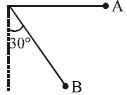
A simple pendulum is released from $A$ as shown in figure. If $m$ and $l$ represent the mass of the bob and the length of the pendulum respectively, the gain in kinetic energy at $B$ is