MCQ
The correct relationship between molality $(m)$ and molarity $(M)$ of a solution is ($d =$ density in $g/ml$ )
  • A
    $m = \frac{d}{M} - \frac{{1000}}{{{M_{\left( {solute} \right)}}}}$
  • B
    $\frac{1}{m} = \frac{M}{d} - \frac{{1000}}{{{M_{\left( {solute} \right)}}}}$
  • $\frac{1}{m} = \frac{d}{M} - \frac{{{M_{\left( {solute} \right)}}}}{{1000}}$
  • D
    $\frac{1}{m} = \frac{d}{M} \times \frac{{{M_{\left( {solute} \right)}}}}{{1000}}$

Answer

Correct option: C.
$\frac{1}{m} = \frac{d}{M} - \frac{{{M_{\left( {solute} \right)}}}}{{1000}}$
c

Need a full question paper?

Generate a complete, print-ready paper with questions like this in minutes — across 16+ boards, with answer keys.

Start Generating Free

Similar questions

For a solution of volatile liquids the partial vapour pressure of each component in solution is directly proportional to
Which of the following intermediate is not expected to be formed in the following reaction ?
$2C{H_3}COOH\mathop {\xrightarrow{{MnO}}}\limits_{{{300}\,^o}C} A$  , product ‘$A$’ in the reaction is
Ethanoic acid on heating with ammonia forms compound $A$ which on treatment with bromine and sodium hydroxide gives compound $B$. Compound $B$ on treatment with $NaNO_2$ /dil. $HCl$ gives compound $C$. The compounds $A,\,B$ and $C$ respectively are
When a metal rod ${M}$ is dipped into an aqueous colourless concentrated solution of compound ${N}$, the solution turns light blue. Addition of aqueous $\mathrm{NaCl}$ to the blue solution gives a white precipitate ${O}$. Addition of aqueous $\mathrm{NH}_3$ dissolves ${O}$ and gives an intense blue solution.

$1.$ The metal rod ${M}$ is

$(A)$ $\mathrm{Fe}$ $(B)$ $\mathrm{Cu}$ $(C)$ $\mathrm{Ni}$ $(D)$ $\mathrm{Co}$

$2.$ The compound ${N}$ is

$(A)$ $\mathrm{AgNO}_3$ $(B)$ $\mathrm{Zn}\left(\mathrm{NO}_3\right)_2$

$(C)$ $\mathrm{Al}\left(\mathrm{NO}_3\right)_3$ $(D)$ $\mathrm{Pb}\left(\mathrm{NO}_3\right)_2$

$3.$ The final solution contains

$(A)$ $\left[\mathrm{Pb}\left(\mathrm{NH}_3\right)_4\right]^{2+}$ and $\left[\mathrm{CoCl}_4\right]^{2-}$

$(B)$ $\left[\mathrm{Al}\left(\mathrm{NH}_3\right)_4\right]^{3+}$ and $\left[\mathrm{Cu}\left(\mathrm{NH}_3\right)_4\right]^{2+}$

$(C)$ $\left[\mathrm{Ag}\left(\mathrm{NH}_3\right)_2\right]^{+}$and $\left[\mathrm{Cu}\left(\mathrm{NH}_3\right)_4\right]^{2+}$

$(D)$ $\left[\mathrm{Ag}\left(\mathrm{NH}_3\right)_2\right]^{+}$and $\left[\mathrm{Ni}\left(\mathrm{NH}_3\right)_6\right]^{2+}$

Give the answer question $1,2$ and $3.$
The element which is the most abundant in the earth crust is
A gas reacts with $CaO$, but not with $NaHC{O_3}$. The gas is
Ethanol on reaction with acetic anhydride gives:
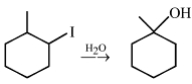
For the given reaction major product will be

 Major product

Which of the following is a disaccharide
