MCQ
The correct representation of CuSO4​⋅5H2​O is:
  • A
    [Cu(H2​O)5​]SO4​
  • B
    [Cu(H2​O)3​SO4​]⋅2H2​O
  • C
    [CuSO4​⋅H2​O]⋅4H2​O
  • D
    [Cu(H2​O)4​]SO4​⋅H2​O

Answer

  1. [Cu(H2​O)4​]SO4​⋅H2​O

Explanation:

For,

CuSO4​.5H2​O in this 4H2​O are bonded by co-ordinate bond and 1H2​O by covalent bonding.

Therefore,

Its formula of the compound is [Cu(H2​O)4​]SO4​⋅H2​O.

Need a full question paper?

Generate a complete, print-ready paper with questions like this in minutes — across 16+ boards, with answer keys.

Start Generating Free

Similar questions

Which of the following species can act as reducing agent ?
Which metal can not produce H2gas by reaction with HCI solution?
$\begin{array}{ll} E _{ Fe ^{2+} / Fe }^0=-0.44 V & E _{{ Cu / Cu ^{2+}}}=-0.34 V \\ E _{ Nt ^{2+} / Ni }^0=-0.25 V & E _{ Zn ^{2+}}/zn=-0.76 V\end{array}$
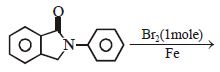
product of the reaction is
In the reaction the major product formed is
Indigestible carbohydrate, which is also a constituent of our diet, is
At $300\, K$, the vapour pressure of a solution containing $1$ mole of $n-$hexane and $3$ moles of $n-$heptane is $550\, mm$ of $Hg$. At the same temperature, if one more mole of n-heptane is added to this solution, the vapour pressure of the solution increases by $10\, mm$ of $Hg$. What is the vapour pressure in $mm Hg$ of $n-$heptane in its pure state..........$?$
$1000\,gms$ aqueous solution of $CaC{O_3}$ contains $10\,gms$  of carbonate. Concentration of the solution is .......... $ppm$.
A solution containing $2.5 \times 10^{-3}\, kg$ of a solute dissolved in $75 \times 10^{-3} \,kg$ of water boils at $373.535$ $K$. The molar mass of the solute is $.....\,g\, mol ^{-1}$. [nearest integer] (Given: $K _{ b }\left( H _{2} O \right)=0.52 \,K\, Kg\,mol ^{-1}$, boiling point of water $=373.15 \,K$ )
A six coordinate complex of formula $CrCl_3 .6H_2O$ has green colour. A $0.1\,M$ solution of the complex when treated with excess of $AgNO_3$ gave $28. 7g$ of white precipitate. The formula of the complex would be
Ratio of time taken to complete $60\%$ and $20\%$ of first order reaction $[A \rightarrow $ product $]$ is : $(\log\,2 = 0.3)$