MCQ
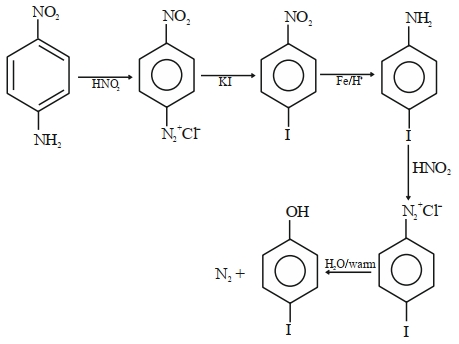
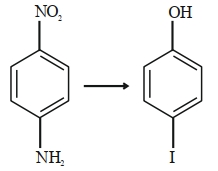
The correct sequential order of the reagents for the given reaction is.
  • A
    $HNO _{2}, Fe / H ^{+}, HNO _{2}, KI , H _{2} O / H ^{+}$
  • $HNO _{2}, KI , Fe / H ^{+}, HNO _{2}, H _{2} O /$ warm
  • C
    $HNO _{2}, KI , HNO _{2}, Fe / H ^{+}, H _{2} O / H ^{+}$
  • D
    $HNO _{2}, Fe / H ^{+}, KI , HNO _{2}, H _{2} O /$ warm

Answer

Correct option: B.
$HNO _{2}, KI , Fe / H ^{+}, HNO _{2}, H _{2} O /$ warm
b

Need a full question paper?

Generate a complete, print-ready paper with questions like this in minutes — across 16+ boards, with answer keys.

Start Generating Free

Similar questions

The $3d-$ elements show variable oxidation states. What is the maximum oxidation state shown by the element $Mn$
Match List $I$ with List $II$

List $I$ Complex List $II$ $CFSE(\Delta_0)$
$A$ $\left[ Cu \left( NH _3\right)_6\right]^{2+}$ $I$ $-0.6$
$B$ $\left[\operatorname{Ti}\left( N _2 O \right)_6\right]^{3+}$ $II$ $-2.0$
$C$ $\left[ Fe ( CN )_6\right]^{3-}$ $III$ $-1.2$
$D$ $\left[ NiF _6\right]^{4-}$ $IV$ $-0.4$

Choose the correct answer from the options given below:

The decreasing order of rate of ${{S}_{{{N}^{1}}}}$ reaction for the following compounds is

$(I)$  $\begin{matrix}
   \begin{matrix}
   \,\,\,Br  \\
   |  \\
\end{matrix}  \\
   Ph-C-Ph  \\
   |  \\
   \,\,\,\,\,\,C{{H}_{3}}  \\
\end{matrix}$

$(II)$  $\begin{matrix}
   Br  \\
   |\,\,\,  \\
   Ph-CH-Ph  \\
\end{matrix}$

$(III)$  $\begin{matrix}
   Ph-CH-C{{H}_{3}}  \\
   |\,\,\,\,\,\,\,  \\
   Br\,\,\,\,\,\,  \\
\end{matrix}$

$(IV)$  $PhVH_2Br$

Which of the following compound will make precipitate most readily with $AgN{O_3}$
$C_3H_6Br_2$ can shows :
Bond angle in $P_4$ molecule is:
The compound $I$ and $II$ are related as

$\mathop {\begin{array}{*{20}{c}}
  {\begin{array}{*{20}{c}}
  {COOH\,\,} \\ 
  {|\,\,\,\,\,\,\,\,\,\,\,\,\,\,\,} \\ 
  {H - C - OH\,\,\,\,\,\,\,\,\,\,\,} \\ 
  {|\,\,\,\,\,\,\,\,\,\,\,\,\,\,\,} 
\end{array}} \\ 
  {Br - C - H\,\,\,\,\,\,\,\,\,\,\,\,\,\,\,\,\,} \\ 
  {|\,\,\,\,\,\,\,\,\,\,\,\,\,\,\,\,\,} \\ 
  {\,\,\,COOC{H_3}} 
\end{array}}\limits_{(I)} $ $\mathop {\begin{array}{*{20}{c}}
  {\begin{array}{*{20}{c}}
  {\,\,\,\,\,\,\,\,COOC{H_3}\,\,} \\ 
  {|\,\,\,\,\,\,\,\,\,\,\,\,\,\,\,} \\ 
  {H - C - Br\,\,\,\,\,\,\,\,\,\,\,} \\ 
  {|\,\,\,\,\,\,\,\,\,\,\,\,\,\,\,} 
\end{array}} \\ 
  {HO - C - H\,\,\,\,\,\,\,\,\,\,\,\,\,\,\,\,\,} \\ 
  {\,\,|\,\,\,\,\,\,\,\,\,\,\,\,\,\,\,\,\,} \\ 
  {\,\,\,\,\,\,\,COOH\,\,\,\,\,\,\,\,} 
\end{array}}\limits_{(II)} $
Which of the following statements is correct?
$"(A)"$ is
A metal, $M$ forms chlorides in its $+2$ and $+4$ oxidation states. Which of the following statements about these chlorides is correct ?