MCQ
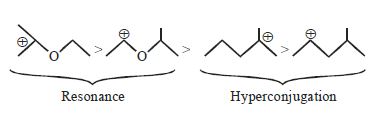
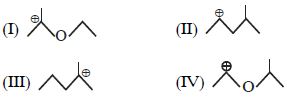
The correct stability order for the following carbocation is
  • A
    $IV > I > III > II$
  • B
    $IV > III > II > I$
  • $I > IV > III > II$
  • D
    $I > III > IV > II$

Answer

Correct option: C.
$I > IV > III > II$
c

Need a full question paper?

Generate a complete, print-ready paper with questions like this in minutes — across 16+ boards, with answer keys.

Start Generating Free

Similar questions

Ozone turns trimethyl paper
$Fac$ and $Mer$ isomerism is associated with which of the following general  formula? 
A nucleotide consists of
The pressure of hydrogen gas is increased from $1\, atm$ to $100\, atm$ keeping the $[{H^ \oplus }]$ constant at $1\, M$. The potential of the hydrogen half-cell at $25\,^oC$ will be .......... $\mathrm{V}$
The elements with atomic number $10, 18, 36, 54$ and $86$ are all
An electrolyte
The compound $\begin{array}{*{20}{c}}
  {C{H_{3\,\,}}\,\,\,\,\,\,\,} \\ 
  {|\,\,\,\,\,\,\,\,\,\,\,\,\,\,\,\,} \\ 
  {C{H_3} - C = CH - C{H_3}} 
\end{array}$ on reaction with $NaI{O_4}$ in the presence of $KMn{O_4}$ gives
Given below are two statements:

Statement-$I$: The orbitals having same energy are called as degenerate orbitals.

Statement-$II$: In hydrogen atom, $3 \mathrm{p}$ and $3 \mathrm{~d}$ orbitals are not degenerate orbitals.

In the light of the above statements, choose the most appropriate answer from the options given

A dilute solution of sulphuric acid is electrolysed using a current of $0.10 \,A$ for $2\, hours$ to produce hydrogen and oxygen gas. The total volume of gases produced at $STP$ is $......\,cm ^{3}$. (Nearest integer) $\lfloor$ Given : Faraday constant $F=96500 \,C$ $mol^{-1}$ at $STP,$ molar volume of an ideal gas is $\left.22.7\, L\, mol^{-1}\right]$
Identify final product in the following reaction

$\begin{matrix}
   C{{H}_{3}}CHCOOH\xrightarrow{\Delta }\,Product  \\
   |\,\,\,\,\,\,\,\,\,\,\,\,\,\,\,\,\,\,\,\,\,\,\,\,\,\,\,\,\,\,\,\,\,\,\,\,\,\,\,\,\,\,\,  \\
   OH\,\,\,\,\,\,\,\,\,\,\,\,\,\,\,\,\,\,\,\,\,\,\,\,\,\,\,\,\,\,\,\,\,\,\,\,\,\,\,  \\
\end{matrix}$