MCQ
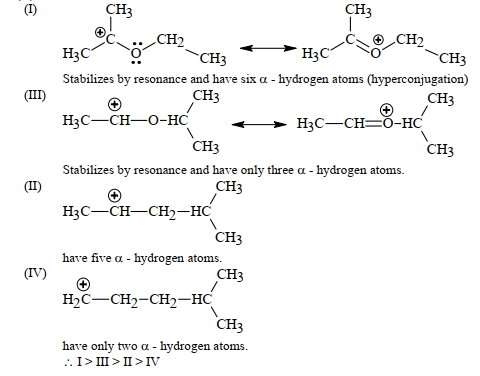
The correct stability order for the following species is

$Image$

  • A
    $(II) > (IV) > (I) > (III)$
  • B
    $(I) > (II) > (III) > (IV)$
  • C
    $(II) > (I) > (IV) > (III)$
  • $(I) > (III) > (II) > (IV)$

Answer

Correct option: D.
$(I) > (III) > (II) > (IV)$
d

Need a full question paper?

Generate a complete, print-ready paper with questions like this in minutes — across 16+ boards, with answer keys.
Start Generating Free

Similar questions

Which of the following pairs give positive Tollen’s test ?
If ${K_f}$ value of ${H_2}O$ is $1.86$. The value of $\Delta {T_f}$ for $0.1\,m$ solution of non-volatile solute is
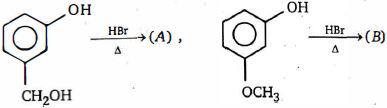
product $(A)$ and $(B)$ are respectally ?
The half cell reaction involving quinhydrone electrode is 

If $E_{op}^o$ for this electrode is $1.30\,volt$ then what will be the oxidation electrode potential at $pH = 3$ ? .............. $\mathrm{volt}$

$(i)\,\,\begin{matrix}
   CHO\,\,\,\,\,\,\,\,\,\,\,\,\,\,\,\,\,\,\,\,\,  \\
   |\,\,\,\,\,\,\,\,\,\,\,\,\,\,\,\,\,\,\,\,\,\,\,\,\,\,\,\,\,\,\,  \\
   {{(CH-OH)}_{3}}\,\,\,\,\,\,  \\
   |\,\,\,\,\,\,\,\,\,\,\,\,\,\,\,\,\,\,\,\,\,\,\,\,\,\,\,\,\,\,\,  \\
   \,\,C{{H}_{2}}-OH\,\,\,\,\,\,\,\,\,\,  \\
\end{matrix}\xrightarrow{4HI{{O}_{4}}} Product$ $(ii)\,\,\begin{matrix}
   C{{H}_{2}}OH\,\,\,\,\,\,\,\,\,\,\,\,\,\,\,\,  \\
   |\,\,\,\,\,\,\,\,\,\,\,\,\,\,\,\,\,\,\,\,\,\,\,\,\,\,\,\,\,\,\,  \\
   {{(CH-OH)}_{4}}\,\,\,\,\,\,  \\
   |\,\,\,\,\,\,\,\,\,\,\,\,\,\,\,\,\,\,\,\,\,\,\,\,\,\,\,\,\,\,\,  \\
   \,\,C{{H}_{2}}-OH\,\,\,\,\,\,\,\,\,\,  \\
\end{matrix}\xrightarrow{5HI{{O}_{4}}} Product$

Ratio of moles of formic acid obtained in reaction $(i)$ and reaction $(ii)$ is
In which compound chromium has $ + \,6$ oxidation state
2.33g of compound X(empirical formula CoH12​N4​Cl3​) upon treatment with excess AgNO3​ solution produces 1.435g of a white precipitate. The primary and secondary valences of cobalt in compound X, respectively, are.
[Given : Atomic mass: Co = 59, Cl = 35.5, Ag = 108].
The most acidic compound among the following is
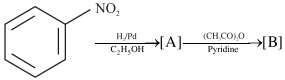
Find $B$
Among the following, which is not the $ \pi$ -bonded organometallic compound