MCQ
The correct statement about the following disaccharide is
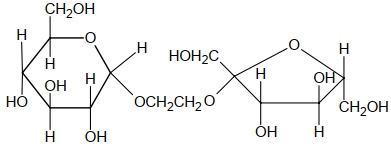
  • Ring $(a)$ is pyranonse with $\alpha$-glycosidic link
  • B
    Ring $(a)$ is furanonse with $\alpha$-glycosidic link
  • C
    Ring $(b)$ is furanonse with $\alpha$-glycosidic link
  • D
    Ring $(b)$ is pyranonse with $\beta$ - glycosidic link

Answer

Correct option: A.
Ring $(a)$ is pyranonse with $\alpha$-glycosidic link
a
$(A)$ ring $(i)$ is pyranose with $\alpha$-glycosidic link

The six-membered cyclic structure of glucose is called pyranose structure ( $\alpha$ - or $\beta-$ ), in analogy with pyran which is a cyclic organic compound with one oxygen and five carbon atoms in the ring.

Hence, ring $(i)$ is pyranose.

The ring $(i)$ is pyranose with $\alpha$-glycosidic linkage which means the oxide linkage which connects the monosaccharide units in polysaccharide below the plane.

Need a full question paper?

Generate a complete, print-ready paper with questions like this in minutes — across 16+ boards, with answer keys.

Start Generating Free

Similar questions

At $298\,K$, a 1 litre solution containing $10\,m\,mol$ of $Cr _2 O _7{ }^{2-}$ and $100\,m\,mol$ of $Cr ^{3+}$ shows a $pH$ of $3.0$.

Given : $Cr _2 O _7^{2-} \rightarrow Cr ^{3+} ; E ^0=1.330\,V$ and

$\frac{2.303 RT }{ F }=0.059\,V$

The potential for the half cell reaction is $x \times 10^{-3}\,V$. The value of $x$ is $........$

How many types of solution are possible in nature?
For the given reaction 'D' will be :
Image
In the reaction :

$\begin{array}{*{20}{c}}
  {C{H_3}\,\,\,\,\,\,\,\,\,\,\,\,\,\,\,\,\,\,\,\,\,\,\,\,\,\,\,\,\,\,\,\,\,\,\,\,\,\,\,\,\,\,\,\,\,} \\ 
  {|\,\,\,\,\,\,\,\,\,\,\,\,\,\,\,\,\,\,\,\,\,\,\,\,\,\,\,\,\,\,\,\,\,\,\,\,\,\,\,\,\,\,\,\,\,\,\,\,\,\,\,\,\,} \\ 
  {C{H_3} - CH - C{H_2} - O - C{H_2} - C{H_3}} 
\end{array}\,+ HI \, \xrightarrow{{Heated}}$

Which of the following compounds will be formed ?

Vapour pressure of solution of benzene $(P^o = 120\,torr)$ and toluene $(P^o = 80\, torr)$ having $2\,moles$ of each is ......... $torr.$
Which of the following is not Ambidentate ligand
IUPAC name of [Pt(NH3)2 Cl(NO2)] is:
Reaction rate between two substance $A$ and $B$ is expressed as following $:$ rate $= k[A ]^n[B]^m$ If the concentration of $A$ is doubled and concentration of $B$ is made half of initial concentration, the ratio of the new rate to the earlier rate will be
The order of reactivity of following alcohols with halogen acids is ___________.

  1. $\text{CH}_3\text{CH}_2-\text{CH}_2-\text{OH}$

  2. $\text{CH}_3\text{CH}_2-\text{CH}-\text{OH}\\ \ \ \ \ \ \ \ \ \ \ \ \ \ \ \ \ \ \ \ \ \ | \\ \ \ \ \ \ \ \ \ \ \ \ \ \ \ \ \ \ \ \ \ \text{CH}_3$

  3. $\ \ \ \ \ \ \ \ \ \ \ \ \ \ \ \ \ \ \ \ \text{CH}_3 \\ \ \ \ \ \ \ \ \ \ \ \ \ \ \ \ \ \ \ \ \ \ |\ \ \ \ \ \ \ \ \ \ \ \ \ \ \ \ \ \ \ \ \ \\\text{CH}_3\text{CH}_2-\text{C}-\text{OH}\\ \ \ \ \ \ \ \ \ \ \ \ \ \ \ \ \ \ \ \ \ \ | \\ \ \ \ \ \ \ \ \ \ \ \ \ \ \ \ \ \ \ \ \ \text{CH}_3$

    If one strand of a $DNA$ has the sequence $ATGCTTCA$, sequence of the bases in complementary strand is: