MCQ
The correct statement regarding $RNA$ and $DNA,$ respectively is
  • A
    the sugar component in $RNA$ is a arabinose and the sugar component in $DNA$ is ribose
  • B
    the sugar component in $RNA$ is $2'-$deoxyribose and the sugar component in $DNA$ is arabinose
  • C
    the sugar component in $RNA$ is arabinose and the sugar component in $DNA$ is $2'-$deoxyribose
  • the sugar component in $RNA$ is ribose and the sugar component in $DNA$ is $2'-$deoxyribose.

Answer

Correct option: D.
the sugar component in $RNA$ is ribose and the sugar component in $DNA$ is $2'-$deoxyribose.
d

Need a full question paper?

Generate a complete, print-ready paper with questions like this in minutes — across 16+ boards, with answer keys.

Start Generating Free

Similar questions

Which one of the following compounds does not react with bromine
For the reaction

$\mathrm{A}+\mathrm{B} \rightleftharpoons 2 \mathrm{C}$

the value of equilibrium constant is $100$ at $298\, \mathrm{~K}$. If the initial concentration of all the three species is $1\, \mathrm{M}$ each, then the equilibrium concentration of $\mathrm{C}$ is $\mathrm{X} \times 10^{-1} \,\mathrm{M}$. The value of $\mathrm{x}$ is $.....$ (Nearest integer)

$O_2 F_2$ is an unstable yellow orange solid and $H_2O_2$ is a colourless  liquid, both have $O-O$ bond and $O-O$ bond length in $H_2O_2$ and $O_2F_2$ respectively is
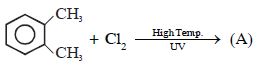
The product $(A)$ formed in the following reaction
Isobutyl magnesium bromide with dry ether and absolute alcohol gives
Which of the following arrangements shows the correct order of decreasing paramagnetism?
Given below are two statements :

Statement $I :$ The esterification of carboxylic acid with an alcohol is a nucleophilic acyl substitution.

Statement $II :$ Electron withdrawing groups in the carboxylic acid will increase the rate of esterification reaction.

Choose the most appropriate option

The $IUPAC$ symbols for the element with atomic number $119$ would be:
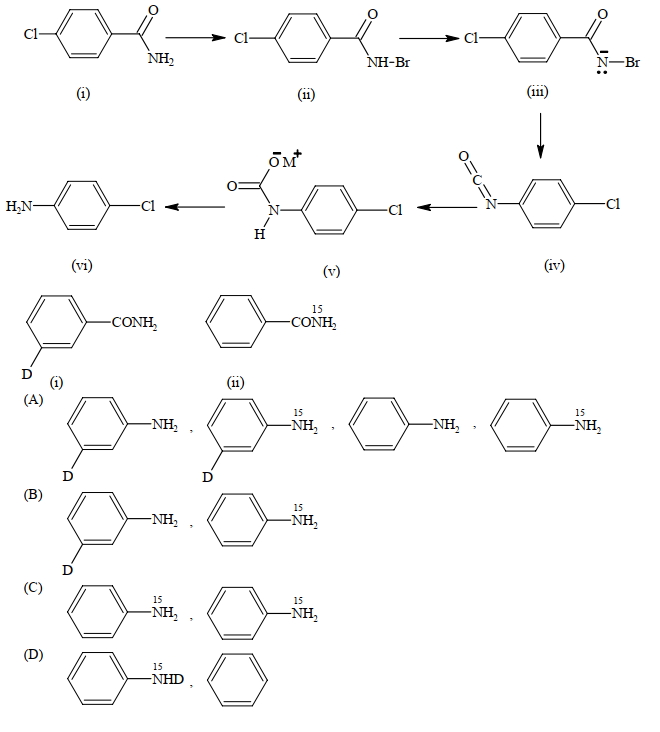
$\mathrm{RCONH}_2$ is converted into $\mathrm{RNH}_2$ by means of Hofmann bromamide degradation.

$Image$

In this reaction, $\mathrm{RCONHBr}$ is formed from which this reaction has derived its name. Electron donating group at phenyl activates the reaction. Hofmann degradation reaction is an intramolecular reaction.

$1.$  How can the conversion of $(i)$ to $(ii)$ be brought about?

$(A)$ $\mathrm{KBr}$  $(B)$ $\mathrm{KBr}+\mathrm{CH}_3 \mathrm{ONa}$  $(C)$ $\mathrm{KBr}+\mathrm{KOH}$  $(D)$ $\mathrm{Br}_2+\mathrm{KOH}$

$2.$  Which is the rate determining step in Hofmann bromamide degradation?

$(A)$ Formation of $(i)$  $(B)$ Formation of $(ii)$  $(C)$ Formation of $(iii)$  $(D)$ Formation of $(iv)$

$3.$  What are the constituent amines formed when the mixture of $(i)$ and $(ii)$ undergoes Hofmann bromamide degradation?

$Image$

give the answer question $1$, $2$, and $3.$

Consider the following statements : According the Werner's theory.

$(1)$ Ligands are connected to the central metal ions by covalent bonds.

$(2)$ Secondary valencies have directional properties

$(3)$ Secondary valencies are non-ionisable Of these statements