MCQ
The correct structural formula of zeise's salt is
  • ${K^ + }{\left[ {PtC{l_3} - {\eta ^2} - ({C_2}{H_4})} \right]^ - }$
  • B
    ${K_2}\left[ {PtC{l_3} - {\eta ^2} - {C_2}{H_4}} \right]$
  • C
    ${K^ + }\left[ {PtC{l_2} - {\eta ^2} - ({C_2}{H_4})} \right]C{l^ - }$
  • D
    ${K^ + }{\left[ {PtC{l_3}({C_2}{H_4}} \right]^ - }$

Answer

Correct option: A.
${K^ + }{\left[ {PtC{l_3} - {\eta ^2} - ({C_2}{H_4})} \right]^ - }$
a
It’s obvious.

Need a full question paper?

Generate a complete, print-ready paper with questions like this in minutes — across 16+ boards, with answer keys.

Start Generating Free

Similar questions

Calculate the e.m.f. of the half cells given below ............ $\mathrm{V}$ 

$Fe|FeSO_4$         $E^o_{OP} = 0.44\, V$        $(a = 0.1\, M)$

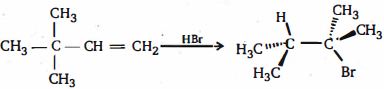
Consider the addition of $HBr$ to $3,3$ -Dimethyl- $1$ -butene shown below. What is  the best mechanistic explanation for the formation of the observed product ?
For the reaction, $H _2(g)+ Br _2(g)=2 HBr ( g )$, the reaction rate $= K \left[ H _2\right]\left[ Br _2\right]^{1 / 2}$. Which statement is true about this reaction?
The atomic orbital is:
Total number of right angles $\angle ClPCl$ Present in $PC{l_5},\,PCl_4^- ,\,PCl_6^-$ are ___, ___, ___
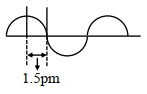
A hypothetical electromagnetic wave is show below.

(Image)

The frequency of the wave is $\mathrm{x} \times 10^{19} \mathrm{~Hz}$. $x=$ . . . .  (nearest integer)

The concentration of potassium ions inside a biological cell is at least twenty times higher than the outside. The resulting potential difference across the cell is important in several processes such as transmission of nerve impulses and maintaining the ion balance. A simple model for such a concentration cell involving a metal $\mathrm{M}$ is:

$\mathrm{M}(\mathrm{s}) \mid \mathrm{M}^{+}$(aq; $0.05$ molar) || $\mathrm{M}^{+}(\mathrm{aq}), 1$ molar) $\mid \mathrm{M}(\mathrm{s})$

For the above electrolytic cell the magnitude of the cell potential $\left|E_{\text {cell }}\right|=70 \mathrm{mV}$.

$1.$ For the above cell

$(A)$ $\mathrm{E}_{\text {cell }}<0 ; \Delta \mathrm{G}>0$ $(B)$ $\mathrm{E}_{\text {cell }}>0 ; \Delta \mathrm{G}<0$

$(C)$ $\mathrm{E}_{\text {cell }}<0 ; \Delta \mathrm{G}^{\circ}>0$ $(D)$ $\mathrm{E}_{\text {cell }}>0 ; \Delta \mathrm{G}^{\circ}>0$

$2.$ If the $0.05$ molar solution of $\mathrm{M}^{+}$is replaced by $0.0025$ molar $\mathrm{M}^{+}$solution, then the magnitude of the cell potential would be

$(A)$ $35 \mathrm{mV}$ $(B)$ $70 \mathrm{mV}$ $(C)$ $140 \mathrm{mV}$ $(D)$ $700 \mathrm{mV}$

Give the answer question $1,2.$ 
Which of the following is known as hydronium ion
In the reaction $HAs{O_2} + S{n^{2 + }} \to As + S{n^{4 + }} + {H_2}O$ oxidising agent is
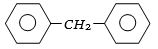
The molecular formula of diphenyl methane, , is ${C_{13}}{H_{12}}$ How many structural isomers are possible when one of the hydrogens is replaced by a chlorine atom