Question
The count rate from a radioactive sample falls from 4.0 × 10⁶ per second to 1.0 × 10per second in 20 hours. What will be the count rate 100 hours after the beginning?

Answer

$\text{A}_0=4\times10^5$ disintegration/sec

$\text{A}'=1\times10^6$ dis/sec; t = 20 hours.

$\text{A}'=\frac{\text{A}_0}{2^{\frac{\text{t}}{\text{t}_{\frac{1}{2}}}}}\Rightarrow2^{\frac{\text{t}}{\text{t}_{\frac{1}{2}}}}=\frac{\text{A}_0}{\text{A}'}\Rightarrow2^{\frac{\text{t}}{\text{t}_{\frac{1}{2}}}}=4$

$\Rightarrow\frac{\text{t}}{\text{t}_{\frac{1}{2}}}=2\Rightarrow\text{t}^{\frac{1}{2}}=\frac{\text{t}}{2}=\frac{20\text{ hours}}{2}=10\text{ hours}.$

$\text{A}''=\frac{\text{A}_0}{2^{\frac{\text{t}}{\text{t}_{\frac{1}{2}}}}}\Rightarrow\text{A}''=\frac{4\times10^6}{2^{\frac{100}{10}}}$

$=0.00390625\times10^6=3.9\times10^3$ dintegrations/sec.

Need a full question paper?

Generate a complete, print-ready paper with questions like this in minutes — across 16+ boards, with answer keys.
Start Generating Free

Similar questions

What potential difference should be applied across an X-ray tube to get X-ray of wavelength not less than 0.10nm? What is the maximum energy of a photon of this X-ray in joule?
The radius of gyration of a uniform disc about a line perpendicular to the disc equals its radius. Find the distance of the line from the centre.
If the initial velocity of a particle is u and collinear acceleration at any time t is $\text{a}\propto\text{t}.$ calculate the final velocity of the particle after time t.
What is concurrent force? What is the necessary condition for the balance of concurrent forces?
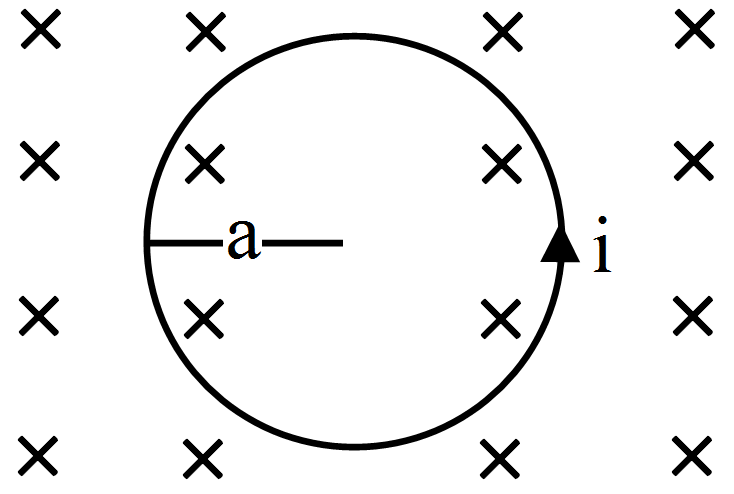
The shows a circular wire loop of radius a and carrying a current i, which is placed in a perpendicular magnetic field B.
  1. Consider a small part dl of the wire. Find the force on this part of the wire exerted by the magnetic field.
  2. Find the force of compression in the wire.

A metre scale made of steel is calibrated at 20°C to give correct reading. Find the distance between the 50cm mark and the 51cm mark if the scale is used at 10°C. Coefficient of linear expansion of steel is 1.1 × 10⁻⁵ °C-1.
By what fraction does the mass of a boy increase when he starts running at a speed of 12km/h?
A body of mass 'M' at rest is struck by a body of mass 'm'. Show that the fraction of K.E. of mass m transferred to the struck particle is $\frac{4\text{mM}}{(\text{m}+\text{M})^2}.$
On what factors does the magnitude of heat flow from hot surface to cold surface depends? How?
Two vessels have the same base area but different shapes. The first vessel takes twice the volume of water that the second vessel requires to fill upto a particular common height. Is the force exerted by the water on the base of the vessel the same in the two cases ? If so, why do the vessels filled with water to that same height give different readings on a weighing scale?