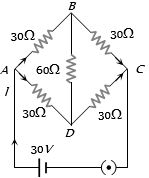
The current between $B$ and $D$ in the given figure is .............. $amp$
A$1$
B$2$
C$0$
D$0.5$
Easy
Download our app for free and get started
C$0$
c (c) Given circuit is a balanced Wheatstone bridge i.e. potential difference between $B$ and $D$ is zero. Hence, no current flows between $B$ and $D$.
Download our app
and get started for free
Experience the future of education. Simply download our apps or reach out to us for more information. Let's shape the future of learning together!No signup needed.*
A constant electric current $I$ is passed through a straight conductor of length $l$. If $S$ in specific charge of electron then the total momentum of electrons is
The resistance of $10\, metre$ long potentiometer wire is $1\,ohm/meter$. A cell of $e.m.f.$ $2.2\, volts$ and a high resistance box are connected in series to this wire. The value of resistance taken from resistance box for getting potential gradient of $2.2\, millivolt/metre$ will be ............... $\Omega $
Two resistors are connected $(a)$ in series $(b)$ in parallel. The equivalent resistance in the two cases are $9$ $ohm$ and $2$ $ohm$ respectively. Then the resistances of the component resistors are
$A, \,B$ and $C$ are voltmeters of resistance $R, \,1 .5R$ and $3R$ respectively as shown in the figure. When some potential difference is applied between $X$ and $Y,$ the voltmeter readings are $V_A, \,V_B$ and $V_C$ respectively. Then
An electric kettle has two heating coils. When one coil is used, water in the kettle boils in $5$ minutes, while when second coil is used, same water boils in $10\,\min$. If the two coils, connected in parallel are used simultaneously, the same water will boil in time
Figure shows a thick shell made of electrical conductivity $\sigma$ and has inner & outer radii of $10\ cm$ & $20\ cm$ respectively and is filled with ice inside it. Its inside and outside surface are kept at different potentials by a battery of internal resistance $\frac{2}{\pi} \Omega \ \&\ \epsilon = 5V$. Find value of $\sigma$ for which ice melts at maximum possible rate if $25\%$ of heat generated by shell due to joule heating is used to melt ice.
Variation of current passing through a conductor as the voltage applied across its ends as varied is shown in the adjoining diagram. If the resistance $(R)$ is determined at the points $A$, $B$, $C$ and $D$, we will find that
Consider the circuit shown below where all resistors are $1 \,k \Omega$. If a current of magnitude $1 \,mA$ flows through the resistor marked $X$, the potential difference measured between points $P$ and $Q$ are ..............$V$