The current density is a solid cylindrical wire of radius $R ,$ as a function of radial distance $r$ is given by $J ( r )= J _{0}\left(1-\frac{ r }{ R }\right) .$ The total current in the radial region $r =0$ to $r =\frac{ R }{4}$ will be
AIIMS 2019, Diffcult


Download our appand get started for free
Experience the future of education. Simply download our apps or reach out to us for more information. Let's shape the future of learning together!No signup needed.*
Similar Questions
- 1A heating element has a resistance of $100\,\Omega $ at room temperature. When it is connected to a supply of $220\,V,$ a steady current of $2\,A$ passes in it and temperature is $500\,^oC$ more than room temperature. What is the temperature coefficient resistance of the heating element?View Solution
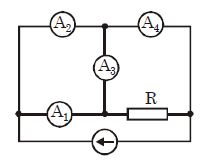
- 2Four ammeters with identical internal resistances $r$ and a resistor of resistance $R$ are connected to a current source as shown in figure. It is known that the reading of the ammeter $A_1$ is $I_1 = 3\ A$ and the reading of the ammeter $A_2$ is $I_2 = 5\ A$ . Determine the ratio of the resistances $R/r$ .View Solution
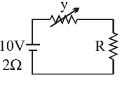
- 3In the figure shown the power generated in $y$ is maximum when $y = 5\,\Omega $. Then $R$ isView Solution
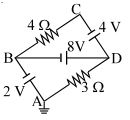
- 4The figure shows a network of resistances in which the point $A$ is earthed. The current through the $4\,\Omega$ resistor isView Solution
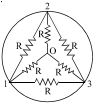
- 5Inside $a$ super conducting ring six identical resistors each of resistance $R$ are connected as shown in figure. The equivalent resistance $(s)$View Solution
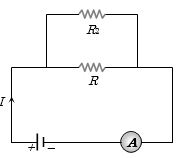
- 6If a resistance ${R_2}$ is connected in parallel with the resistance $R$ in the circuit shown, then possible value of current through $R$ and the possible value of ${R_2}$ will beView Solution
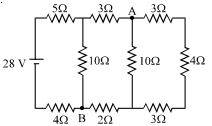
- 7View SolutionConsider the circuit shown in the figure
- 8The heating coils rating at $220\, volt$ and producing $50\, cal/sec$ heat are available with the resistances $55\,\Omega $ , $110\,\Omega$ , $220\,\Omega $ and $440\,\Omega $. The heater of maximum power will be of............. $\Omega$View Solution
- 9$10$ wires (same length, same area, same material) are connected in parallel and each has $1$ $\Omega$ resistance, then the equivalent resistance will be .............. $\Omega$View Solution
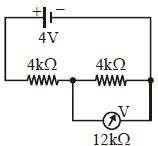
- 10The percentage error in the reading of the voltmeter in the figure shown here is nearly ............ $\%$View Solution