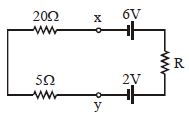
The current flowing in the given circuit is $0.1\,A$ . The potential difference between the points $X$ and $Y$ is ................ $\mathrm{V}$
A$4$
B$3$
C$2.5$
D$2$
Medium
Download our app for free and get started
C$2.5$
c
Download our app
and get started for free
Experience the future of education. Simply download our apps or reach out to us for more information. Let's shape the future of learning together!No signup needed.*
In the circuit shown in figure, the $5\,\Omega $ resistance develops $20.00\,cal/s$ due to the current flowing through it. The heat developed in $2\,\Omega $ resistance (in $cal/s$ ) is
The voltage $V$ and current $I$ graph for a conductor at two different temperatures ${T_1}$ and ${T_2}$ are shown in the figure. The relation between ${T_1}$ and ${T_2}$ is
A current $I$ is passing through a wire having two sections $P$ and $Q$ of uniform diameters $d$ and $d/2$ respectively. If the mean drift velocity of electrons in sections $P$ and $Q$ is denoted by $v_P$ and $v_Q$ respectively, then
A Daniel cell is balanced on $125\,cm$ length of a potentiometer wire. Now the cell is short-circuited by a resistance $2\, ohm$ and the balance is obtained at $100\,cm$. The internal resistance of the Daniel cell is .............. $ohm$
If two wires having resistance $R$ and $2R$. Both joined in series and in parallel then ratio of heat generated in this situation, applying the same voltage,
An insulating pipe of cross-section area $'A'$ contains an electrolyte which has two types of ions $\rightarrow$ their charges being $-e$ and $+2e$. $A$ potential difference applied between the ends of the pipe result in the drifting of the two types of ions, having drift speed $= v$ ($-ve$ ion) and $v/4$ ($+ve$ ion). Both ions have the same number per unit volume $= n$. The current flowing through the pipe is
Two equal resistances when connected in series to a battery, consume electric power of $60\,W.$ If these resistances are now connected in parallel combination to the same battery, the electric power consumed will be .............. $W$
A $100\, W$ bulb $B_1$, and two $60\,W$ bulbs $B_2$ and $B_3$, are connected to a $250\, V$ source, as shown in the figure. Now $ W_1, W_2$ and $W_3$ are the output powers of the bulbs $B_1, B_2$ and $B_3$, respectively. Then
A wire of length $10 \mathrm{~cm}$ and radius $\sqrt{7} \times 10^{-4} \mathrm{~m}$ connected across the right gap of a meter bridge. When a resistance of $4.5 \ \Omega$ is connected on the left gap by using a resistance box, the balance length is found to be at $60 \mathrm{~cm}$ from the left end. If the resistivity of the wire is $\mathrm{R} \times 10^{-7} \Omega \mathrm{m}$, then value of $\mathrm{R}$ is :