MCQ
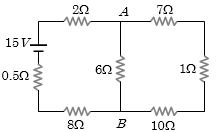
The current from the battery in circuit diagram shown is .............. $A$
  • $1$
  • B
    $2$
  • C
    $1.5$
  • D
    $3$

Answer

Correct option: A.
$1$
a
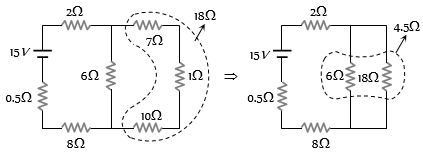
The given circuit can be simplified as follows

On further solving equivalent resistance $R = 15\,\Omega $

Hence current from the battery $i = \frac{{15}}{{15}} = 1\,A$
Need a full question paper?

Generate a complete, print-ready paper with questions like this in minutes — across 16+ boards, with answer keys.

Start Generating Free

Similar questions

Match List $I$ of the nuclear processes with List $II$ containing parent nucleus and one of the end products of each process and then select the correct answer using the codes given below the lists :

List $I$ List $II$
$P.$ $\quad$ Alpha decay  $1.$ $\quad{ }_8^{15} 0 \rightarrow{ }_7^{15} N +\ldots \ldots$.
$Q.$ $\quad$ $\beta^{+}$decay $2.$ $\quad{ }_{92}^{238} U \rightarrow{ }_{90}^{234} Th +\ldots \ldots$.
$R.$ $\quad$Fission $3.$ $\quad{ }_{83}^{185} Bi \rightarrow{ }_{82}^{184} Pb +\ldots \ldots$.
$S.$ $\quad$Proton emission $4.$ $\quad{ }_{94}^{239} Pu \rightarrow{ }_{57}^{140} La +\ldots \ldots$.

Codes: $ \quad \quad P \quad Q \quad R \quad S $ 
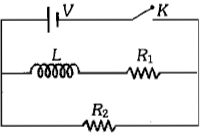
In the circuit shown below, the key $K$ is closed at $t = 0$. The current through the battery is
The magnifying power of an astronomical telescope for relaxed vision is $16$. On adjusting, the distance between the objective and eye lens is $34\, cm$. Then the focal length of objective and eye lens will be respectively
A block of mass $5\,kg$ is moving horizontally at a speed of $1.5\, m/s$. A perpendicular force of $5\,N$ acts on it for $4 \,sec$. What will be the distance of the block from the point where the force started acting ........... $m$
The workdone in an adiabatic change in an ideal gas depends upon only :
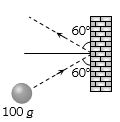
A mass of $100\,g$ strikes the wall with speed $5\,m/s$ at an angle as shown in figure and it rebounds with the same speed. If the contact time is $2 \times {10^{ - 3}}\,\sec $, what is the force applied on the mass by the wall
In the motion of a projectile freely under gravity, its
Which of the following conclusion can be drawn from the result

$\oint {\vec B} .d\vec A\, = \,0$

A man getting down a running bus falls forward because
A ball is projected vertically upward with an initial velocity of $50 \; ms ^{-1}$ at $t =0 \; s$. At $t =2 \,s$. another ball is projected vertically upward with same velocity. At $t= \; \dots \; s$, second ball will meet the first ball $\left( g =10 \; ms ^{-2}\right)$.