Question
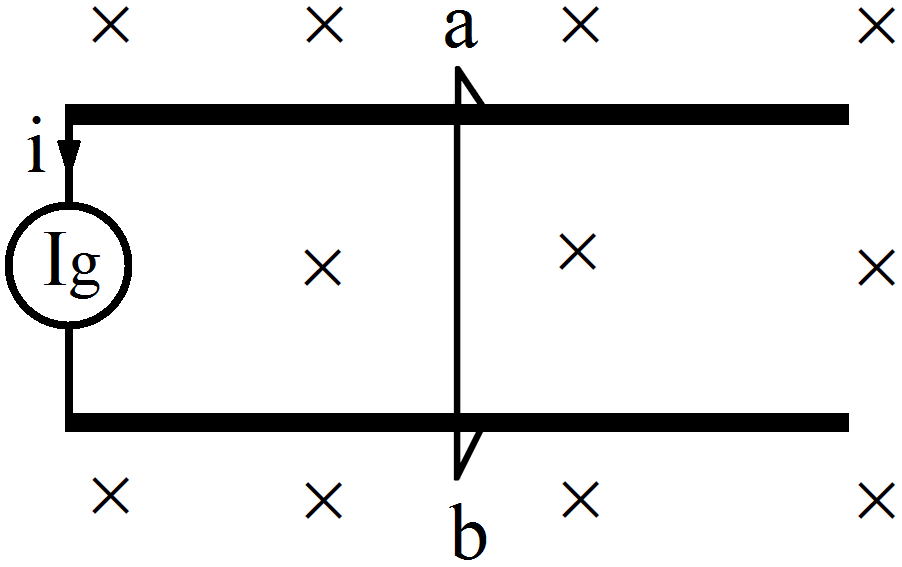
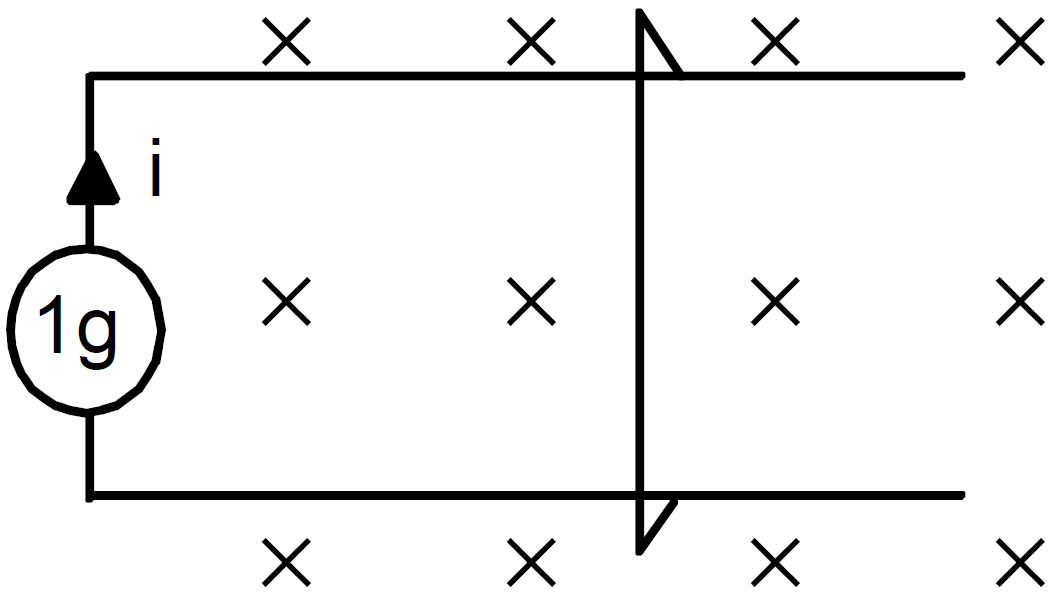
The current generator $I_g$ shown in figure, sends a constant current i through the circuit. The wire ab has a length l and mass m and can slide on the smooth, horizontal rails connected to $I_g.$  The entire system lies in a vertical magnetic field B. Find the velocity of the wire as a function of time.
Answer


Force on the wire $=\text{ilB}$
Acceleration $=\frac{\text{ilB}}{\text{m}}$
Velocity $=\frac{\text{ilBt}}{\text{m}}$

Need a full question paper?

Generate a complete, print-ready paper with questions like this in minutes — across 16+ boards, with answer keys.

Start Generating Free

Similar questions

Obtain the equation of electric potential energy of a system of two electric charges in external electric field.
Two tuning forks vibrate with the same amplitude but the frequency of the first is double the frequency of the second. Which fork produces more intense sound in air?
If a particle of charge q is moving with velocity v along X-axis and the magnetic field B is acting along Y-axis, use the expression $\vec{\text{F}}=\text{q}(\vec{\upsilon}\times\vec{\text{B}})$ to find the direction of force $\vec{\text{F}}$ acting on it.
Explain the concept of hole in intrinsic semiconductors.
Using Bohr model, calculate the electric current created by the electron when the H-atom is in the ground state.
Horizontal component of earth’s magnetic field at a place is $\sqrt{3}$ times its vertical component. What is the value of angle of dip at that place?
Estimate the average drift speed of conduction electrons in a copper wire of cross-sectional area $1.0 \times 10^{-7} \mathrm{~m}^2$ carrying a current of 1.5 A . Assume the density of conduction electrons to be $9 \times 10^{28} \mathrm{~m}^{-3}$.
A metal sphere of radius 1mm and mass 50mg falls vertically in glycerine. Find:
  1. The viscous force exerted by the glycerine on the sphere when the speed of the sphere is 1cm/s.
  2. The hydrostatic force exerted by the glycerine on the sphere and.
  3. The terminal velocity with which the sphere will move down without acceleration. Density of glycerine = $1260kg/m^3$ and its coefficient of viscosity at room temperature = 8.0 poise.
  1. Explain the meaning of the statement ‘electric charge of a body is quantised’.
  2. Why can one ignore quantisation of electric charge when dealing with macroscopic i.e., large scale charges?
The equation $\omega=\frac{\mu_\text{v}-\mu_\text{r}}{\mu-1}$ asderived for a prism having small refracting angle. Is it also valid for a prism of large refracting angle? Is it also valid for a glass slab or a glass sphere?