The current in a conductor varies with time t as $I = 2t + 3{t^2}$ where $I$ is in ampere and $t$ in seconds. Electric charge flowing through a section of the conductor during $t = 2\,\sec$ to $t = 3\,\sec$ is ............. $C$
Medium


Download our appand get started for free
Experience the future of education. Simply download our apps or reach out to us for more information. Let's shape the future of learning together!No signup needed.*
Similar Questions
- 1A resistor dissipates $192\, {J}$ of energy in $1\, {s}$ when a current of $4\, {A}$ is passed through it. Now, when the current is doubled, the amount of thermal energy dissipated in $5 \,{s}$ in $.....\,J.$View Solution
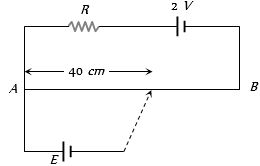
- 2$AB$ is a potentiometer wire of length $100\, cm$ and its resistance is $10 \,\Omega$. It is connected in series with a resistance $R = 40 \,\Omega$ and a battery of $e.m.f.$ $2 \,V$ and negligible internal resistance. If a source of unknown $e.m.f.$ $E$ is balanced by $40\, cm$ length of the potentiometer wire, the value of $E$ is ................. $V$View Solution
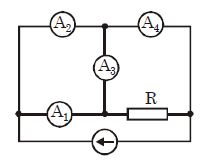
- 3Four ammeters with identical internal resistances $r$ and a resistor of resistance $R$ are connected to a current source as shown in figure. It is known that the reading of the ammeter $A_1$ is $I_1 = 3\ A$ and the reading of the ammeter $A_2$ is $I_2 = 5\ A$ . Determine the ratio of the resistances $R/r$ .View Solution
- 4View SolutionWhen a potential difference is applied across the ends of a linear metallic conductor
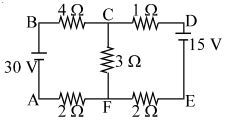
- 5The figure shows a network of five resistances and two batteries The current through the $30\,V$ battery is ............... $A$View Solution
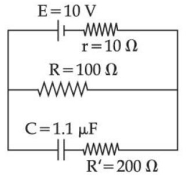
- 6As show in the figure, in steady state, the charge stored in the capacitor is....... $\times 10^{-6}\,C$.View Solution
- 7$A$ current $I$ flows through a uniform wire of diameter $d$ when the mean electron drift velocity is $V$. The same current will flow through a wire of diameter $d/2$ made of the same material if the mean drift velocity of the electron is :View Solution
- 8A horizontal conductor is oriented north south and carries some current. $A$ positively charged particle located vertically above it and having a velocity directed north ward experiences an upward force.What is the direction of the force if this charged particle were located to the east of the conductor and had a velocity directed towards the conductorView Solution
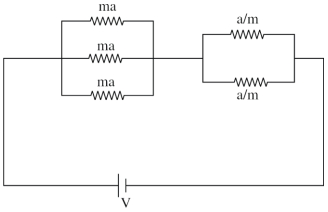
- 9In the given circuit ' $a$ ' is an arbitrary constant. The value of $m$ for which the equivalent circuit resistance is minimum, will be $\sqrt{\frac{ x }{2}}$. The value of $x$ is ...........View Solution
- 10In a Wheatstone's bridge, three resistances $P, Q$ and $R$ connected in the three arms and the fourth arm is formed by two resistances $S_1$ and $S_2$ connected in parallel. The condition for the bridge to be balanced will beView Solution