Question
The current in the following circuit is

|
(a) |
(b) |
(c) |
(d) 1A |
The current in the following circuit is
|
(a) |
(b) |
(c) |
(d) 1A |
(d) 1A
Generate a complete, print-ready paper with questions like this in minutes — across 16+ boards, with answer keys.
The resistance of hot tungsten filament is about 10 times the cold resistance. What will be the resistance of 100 W and 200 V lamp when not in use
|
(a) 400 Ω |
(b) 200 Ω |
(c) 40 Ω |
(d) 20 Ω |
Orbital acceleration of electron is
|
(a) |
(b) |
(c) |
(d) |
Two heater wires of equal length are first connected in series and then in parallel. The ratio of heat produced in the two cases is
|
(a) 2 : 1 |
(b) 1 : 2 |
(c) 4 : 1 |
(d) 1 : 4 |
A particle has a mass 400 times than that of the electron and charge is double than that of a electron. It is accelerated by 5V of potential difference. Initially the particle was at rest, then its final kinetic energy will be
|
(a) 5 eV |
(b) 10 eV |
(c) 100 eV |
(d) 2000 eV |
If an ammeter is to be used in place of a voltmeter then we must connect with the ammeter a
|
(a) Low resistance in parallel |
(b) High resistance in parallel |
|
(c) High resistance in series |
(d) Low resistance in series |
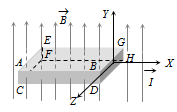
A metallic block carrying current I is subjected to a uniform magnetic induction  as shown in the figure. The moving charges experience a force
  given by ........... which results in the lowering of the potential of the face ........ Assume the speed of the carriers to be v
|
(a) eVB |
(b) eVB |
(c) -eVB |
(d) -eVB |


