MCQ
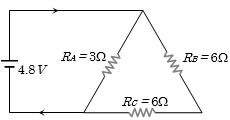
The current in the given circuit is ............ $A$
  • A
    $8.31$
  • B
    $6.82$
  • C
    $4.92$
  • $2$

Answer

Correct option: D.
$2$
d
$6$ $\Omega$ and $6\,\Omega$ are in series,

so effective resistance is $12$ $\Omega$

which is in parallel with $3$ $\Omega$,

so $\frac{1}{R} = \frac{1}{3} + \frac{1}{{12}} = \frac{{15}}{{36}}$

$ \Rightarrow $ $R = \frac{{36}}{{15}}$

$I = \frac{V}{R} = \frac{{4.8 \times 15}}{{36}} = 2\,A$

Need a full question paper?

Generate a complete, print-ready paper with questions like this in minutes — across 16+ boards, with answer keys.
Start Generating Free

Similar questions

In case of closed organ pipe which harmonic the $p^{th}$ overtone will be
Consider a mixture of gas molecule of types $A, B$ and $C$ having masses $m_{A}\,<\,m_{B}\,<\,m_{C}$ ratio of their root mean square speeds at normal temperature and pressure is :
When the length and area of cross-section both are doubled, then its resistance
Let the angle between two nonzero vectors $\overrightarrow A $ and $\overrightarrow B $ be $120^°$ and resultant be $\overrightarrow C $
The ratio of amplitude of magnetic field to the amplitude of electric field for an electromagnetic wave propagating in vacuum is equal to
$25$ tunning forks are arranged in series in the order of decreasing frequency. Any two successive forks produce $3\, beats/sec.$ If the frequency of the first turning fork is the octave of the last fork, then the frequency of the $21^{st}$ fork is .... $Hz$
A body of mass $5\, kg$ is moving in a circle of radius $1\,m$ with an angular velocity of $2$ radian/sec. The centripetal force is ......... $N$
A block $B$ is placed on block $A$. The mass of block $B$ is less than the mass of block $A$. Friction exists between the blocks, whereas the ground on which the block $A$ is placed is taken to be smooth. $A$ horizontal force $F$, increasing linearly with time begins to act on $B$. The acceleration ${a_A}$ and ${a_B}$ of blocks $A$ and $B$ respectively are plotted against $t$. The correctly plotted graph is
Consider a Vernier callipers in which each $1 \ cm$ on the main scale is divided into $8$ equal divisions and a screw gauge with $100$ divisions on its circular scale. In the Vernier callipers, $5$ divisions of the Vernier scale coincide with $4$ divisions on the main scale and in the screw gauge, one complete rotation of the circular scale moves it by two divisions on the linear scale. Then:

$(A)$ If the pitch of the screw gauge is twice the least count of the Vernier callipers, the least count of the screw gauge is $0.01 \ mm$.

$(B)$ If the pitch of the screw gauge is twice the least count of the Vernier callipers, the least count of the screw gauge is $0.005 \ mm$.

$(C)$ If the least count of the linear scale of the screw gauge is twice the least count of the Vernier callipers, the least count of the screw gauge is $0.01 \ mm$.

$(D)$ If the least count of the linear scale of the screw gauge is twice the least count of the Vernier callipers, the least count of the screw gauge is $0.005 \ mm$.

A horizontal conductor is oriented north south and carries some current. $A$ positively charged particle located vertically above it and having a velocity directed north ward experiences an upward force.What is the direction of the force if this charged particle were located to the east of the conductor and had a velocity directed towards the conductor