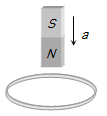
Question

The current inside a copper voltameter

(a) Is half the outside value

(b) Is the same as the outside value

(c) Is twice the outside value

(d) Depends on the concentration of  

Answer

(b) Is the same as the outside value

Need a full question paper?

Generate a complete, print-ready paper with questions like this in minutes — across 16+ boards, with answer keys.

Start Generating Free

Similar questions

A light of wavelength 5890 Å falls normally on a thin air film. The minimum thickness of the film such that the film appears dark in reflected light

(a) 2.945  

(b) 3.945   

(c) 4.95   

(d) 1.945   

A capacitor acts as an infinite resistance for.

What will be the resultant magnetic field at origin due to four infinite length wires. If each wire produces magnetic field 'B' at origin

(a) 4 B

(b)   

(c) 2    

(d) Zero 

A coil of area 80 square cm and 50 turns is rotating with 2000 revolutions per minute about an axis perpendicular to a magnetic field of 0.05 Tesla. The maximum value of the e.m.f. developed in it is

(a) 200π volt

(b)  

(c)  

(d)  volt

In Young’s experiment, monochromatic light is used to illuminate the two slits A and B. Interference fringes are observed on a screen placed in front of the slits. Now if a thin glass plate is placed normally in the path of the beam coming from the slit


(a) The fringes will disappear

(b) The fringe width will increase

(c) The fringe width will increase

(d) There will be no change in the fringe width but the pattern shifts

A charge Q is divided into two parts of q  and Q - q. If the coulomb repulsion between them when they are separated is to be maximum, the ratio of   should be

(a) 2 

(b) 1/2

(c) 4  

(d) 1/4

The equivalent resistance of the circuit shown in the figure is

(a) 8 W

(b) 6 W

(c) 5 W

(d) 4 W

If an α-particle collides head-on with a nucleus, what is its impact parameter?
The motion of a particle is given by $\text{x = A}\sin\omega\text{t+B}\cos\omega\text{t}.$ The motion of the particle is:
  1. Not simple harmonic.
  2. Simple harmonic with amplitude A + B.
  3. Simple harmonic with amplitude $\frac{\text{(A}+\text{B)}}{2}.$
  4. Simple harmonic with amplitude $\sqrt{(\text{A}^2+\text{B}^2)}.$

A metallic ring is attached with the wall of a room. When the north pole of a magnet is brought near to it, the induced current in the ring will be

(a)  First clockwise then anticlockwise

(b)  In clockwise direction

(c)  In anticlockwise direction

(d)  First anticlockwise then clockwise