MCQ
The current sensitivity of a moving coil galvanometer can be increased by
  • A
    Increasing the magnetic field of the permanent magnet
  • B
    Increasing the area of the deflecting coil
  • C
    Increasing the number of turns in the coil
  • a, b, c

Answer

Correct option: D.
a, b, c
 a, b, c

Need a full question paper?

Generate a complete, print-ready paper with questions like this in minutes — across 16+ boards, with answer keys.
Start Generating Free

Similar questions

Total internal reflection is possible when light rays travel
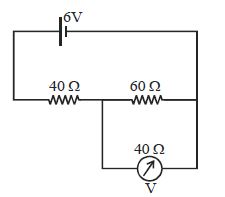
The reading of voltmeter in the circuit shown is ............. $V$
There is 10 units of charge at the centre of a circle of radius 10m. The work done in moving 1 unit of charge around the circle once is
A solid conducting sphere having a charge $Q$ is surrounded by an uncharged concentric conducting hollow spherical shell. Let the potential difference between the surface of the solid sphere and that of the outer surface of the hollow shell be $V$. If the shell is now given a charge of $-3Q$, the new potential difference between the same two surfaces is......$V$
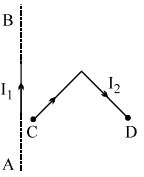
In the figure shown a current $I_1$ is established in the long straight wire $AB$.Another wire $CD$ carrying current $I_2$ is placed in the plane of the paper. The line joining the ends of this wire is perpendicular to the wire $AB$. The force on the wire $CD$ is:
Which of following can not be polarised
Two insulated charged conducting spheres of radii 20 cm and 15 cm respectively and having an equal charge of 10 C are connected by a copper wire and then they are separated. Then
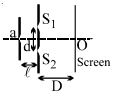
The figure shows a schematic diagram showing the arrangement of Young's Double Slit Experiment If the distance $D$ is varied, then choose the correct statement $(s)$
Electric charges of +10μC, + 5μC, -3μC and +8 μC are placed at the corners of a square of side $\sqrt 2$ m. the potential at the centre of the square is 
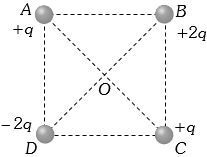
Four charges are arranged at the corners of a square $ABCD$, as shown in the adjoining figure. The force on the charge kept at the centre $O$ is