Question

The current through choke coil increases form zero to 6A in 0.3 seconds and an induced e.m.f. of 30 V is produced. The inductance of the coil of choke is

(a) 5 H     

(b) 2.5 H

(c) 1.5 H  

(d) 2 H

Answer

(c) 1.5 H  

Need a full question paper?

Generate a complete, print-ready paper with questions like this in minutes — across 16+ boards, with answer keys.

Start Generating Free

Similar questions

The electric bulbs have tungsten filaments of same length. If one of them gives 60 watt and other 100 watt, then

(a) 100 watt bulb has thicker filament

(b) 60 watt bulb has thicker filament

(c) Both filaments are of same thickness

(d) It is possible to get different wattage unless the lengths are different

X-rays are produced in X-ray tube operating at a given accelerating voltage. The wavelength of the continuous X-rays has values from

(a) 0 to

(b)   to , where  

(c) 0  to   where  

(d)  to , where 0 <  

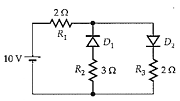
The given circuit has two ideal diodes connected as shown in the figure below. The current flowing through the resistance $R _1$ will be
Image

CO2  gas is found in which of the following pairs of the planet

(a) Earth and Mercury

(b) Mercury and Saturn

(c) Venus and Saturn

(d) Venus and Mars

The resistance of an incandescent lamp is

(a) Greater when switched off

(b) Smaller when switched on

(c) Greater when switched on 

(d) The same whether it is switched off or switched on

In angle of prism and angle of minimum deviation each is A then the refractive index of the material of the prism will be :

Four plates of the same area of cross-section are joined as shown in the figure. The distance between each plate is d. The equivalent capacity across A and B will be

(a)    

(b)

(c)    

(d)  

In a discharge tube at 0.02 mm, there is a formation of

(a) FDS

(b) CDS

(c) Both space

(d) None of these

A fish is a little away below the surface of a lake. If the critical angle is 49°, then the fish could see things above the water surface within an angular range of θ° where

(a) θ =  49°

(b) θ = 90°

(c) θ = 98°

(d) θ = 24

A proton is about 1840 times heavier than an electron. When it is accelerated by a potential difference of 1 kV, its kinetic energy will be: