Question
The curve between current $(i)$ and potential difference $(V)$ for a photo cell will be

Answer

(d) In photocell, at a particular negative potential (stopping potential $V_0$) of anode, photoelectric current is zero,

At the potential difference between cathode and anode increases current through the circuit increases but after some time constant current (saturation current) flows through the circuit even if potential difference still increasing.

Need a full question paper?

Generate a complete, print-ready paper with questions like this in minutes — across 16+ boards, with answer keys.
Start Generating Free

Similar questions

The magnetic potential at a point on the axial line of a bar magnet of dipole moment $M$ is $V$. What is the magnetic potential due to a bar magnet of dipole moment $\frac{M}{4}$ at the same point
A $U-$ tube is such that the diameter of one limb is $0.4\,mm$ and that of other is $d\, mm$ . If the surface tension of water contained in the tube is $0.07\,N/m$ and the difference in the levels of liquid in the limbs is $3.6\,cm,$ then the value of $d$ is
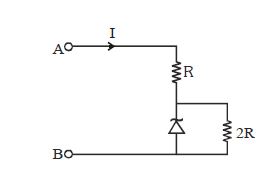
If the voltage between the terminals $A$ and $B$ is $17\ V$ and zener breakdown voltage is $9\ V$ , then the potential voltage across $R$ is.......$V$
A mass $m$ moving horizontally (along the $x-$ axis) with velocity $v$ collides and sticks to a mass of $3\,m$ moving vertically upward (along the $y-$axis) with velocity $2v.$ The final velocity of the combination is
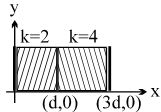
A parallel plate capacitor has two layers of dielectric as shown in figure. This capacitor is connected across a battery. The graph which shows the variation of electric field $(E)$ and distance $(x)$ from left plate.
An electric dipole is placed in an electric field generated by a point charge
$A$ block of mass $M$ is placed on $a$ horizontal surface and it is tied with an inextensible string to $a$ block of mass, as shown in figure. A block of mass $m_0$ is also placed on $M$ If there is no friction between any two surfaces, then
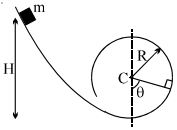
$A$ particle of mass $m$ is released from $a$ height $H$ on $a$ smooth curved surface which ends into a vertical loop of radius $R$, as shown If $\theta$ is instantaneous angle which the line joining the particle and the centre of the loop makes with the vertical, then identify the correct statement $(s)$ related to the normal reaction $N$ between the block and the surface
If momentum of a body is increased by $20 \%$, then its kinetic energy increases by$....\%$
The ratio of secondary to primary turns is $9:4.$ If power input is $P$, what will be the ratio of power output (neglect all losses) to power input