Question
The cut-in voltage for silicon diode is approximately(a) 0.2 V(b) 0.6 V(c) 1.1 V(d) 1.4 V
       

Answer

(b) 0.6 V

Need a full question paper?

Generate a complete, print-ready paper with questions like this in minutes — across 16+ boards, with answer keys.

Start Generating Free

Similar questions

We are able to obtain fairly large currents in a conductor because(a) The electron drift speed is usually very large(b) The number density of free electrons is very high and this can compensate for the low values of the electron drift speed and the very small magnitude of the electron charge(c) The number density of free electrons as well as the electron drift speeds are very large and these compensate for the very small magnitude of the electron charge(d) The very small magnitude of the electron charge has to be divided by the still smaller product of the number density and drift speed to get the electric current


The force between point charges kept in vacuum is 18 Newton. If a glass plate of dielectric constant 6 is placed between these charges, then the value of force will be:
Two long straight parallel conductors separated by a distance of $0.5m$ carry currents of $5A$ and $8A$ in the same direction. The force per unit length experienced by each other is
Free $^{238}U$ nuclei kept in a train emit alpha particles. When the train is stationary and a uranium nucleus decays, a passenger measures that the separation between the alpha particle and the recoiling nucleus becomes $x$ in time $t$ after the decay. If a decay takes place when the train is moving at a uniform speed $v,$ the distance between the alpha particle and the recoiling nucleus at a time $t$ after the decay, as measured by the passenger will be:
The ratio of the wavelengths for $2 \rightarrow 1$ transition in $Li^{++}, He^+$ and $H$ is
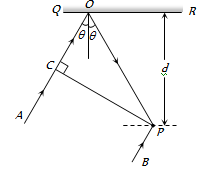
In the adjacent diagram, $CP$ represents a wavefront and $AO\ \&\ BP,$ the corresponding two rays. Find the condition on $q$  for constructive interference at $P$ between the ray $BP$ and reflected ray $OP$
The property which differentiate the two kinds of charges is called as:
In a photon-particle collision, the quantity that does not remain conserved is:
A pendulum clock that keeps correct time on the earth is taken to the moon. It will run:
  1. At correct rate.
  2. 6 times faster.
  3. $\sqrt{6}$ times faster.
  4. $\sqrt{6}$ times slower.
The output of a NAND gate is 0(a) If both inputs are 0(b) If one input is 0 and the other input is 1(c) If both inputs are 1(d) Either if both inputs are 1 or if one of the inputs is 1 and the other 0