MCQ
The de-Broglie wavelength $\lambda$
  • A
    is proportional to mass
  • B
    is proportional to impulse
  • Inversely proportional to impulse
  • D
    does not depend on impulse

Answer

Correct option: C.
Inversely proportional to impulse

Need a full question paper?

Generate a complete, print-ready paper with questions like this in minutes — across 16+ boards, with answer keys.
Start Generating Free

Similar questions

Assertion  : The number of electrons in a P-type silicon semiconductor is less than the number of electrons in a pure silicon semiconductor at room temperature.
Reason      : It is due to law of mass action.(a) If both assertion and reason are true and the reason is the correct explanation of the assertion.(b) If both assertion and reason are true but reason is not the correct explanation of the assertion.(c) If assertion is true but reason is false.(d) If the assertion and reason both are false.


Two heater wires of equal length are first connected in series and then in parallel. The ratio of heat produced in the two cases is(a) 2 : 1 (b) 1 : 2 (c) 4 : 1 (d) 1 : 4
       
The work function of a metal is $hv_{0.}$ Light of frequency $v$ falls on this metal. The photoelectric effect will take place only if$:$
Submarine cables act as
The magnetic induction in air at a distance $d$ from an isolated point pole of strength $m$ unit will be
 
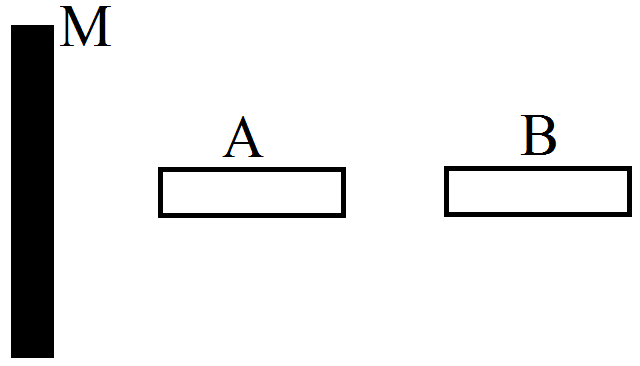
A large nonconducting sheet M is given a uniform charge density. Two uncharged small metal rods A and B are placed near the sheet as shown in figure:
  1. M attracts A.
  2. M attracts B.
  3. A attracts B.
  4. B attracts A.
Susceptibility is positive for:
Those substances whose valence band and conduction band are almost in a state of overlap are :
Light of wavelength 5000 Å falls on a sensitive plate with photoelectric work function of 1.9 eV. The kinetic energy of the photoelectron emitted will be(a) 0.58 eV(b) 2.48 eV(c) 1.24 eV(d) 1.16 eV
       
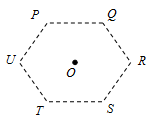
Six charges, three positive and three negative of equal magnitude are to be placed at the vertices of a regular hexagon such that the electric field at $\text{O}$ is double the electric field when only one positive charge of same magnitude is placed at $\text{R}$. Which of the following arrangements of charges is possible for $\text{P, Q, R, S, T}$ and $\text{U}$ respectively