MCQ
The de-Broglie wavelength $\lambda$
  • A
    is proportional to mass
  • B
    is proportional to impulse
  • Inversely proportional to impulse
  • D
    does not depend on impulse

Answer

Correct option: C.
Inversely proportional to impulse
c
(c)The De-Broglie wavelength is $\lambda = \frac{h}{{|p|}} = \frac{h}{{|I|}}$$ \Rightarrow \lambda \propto \frac{1}{{|I|}}$

Need a full question paper?

Generate a complete, print-ready paper with questions like this in minutes — across 16+ boards, with answer keys.
Start Generating Free

Similar questions

Mixed $H{e^ + }$ and ${O^{2 + }}$ ions (mass of $H{e^ + } = 4\,\,amu$ and that of ${O^{2 + }} = 16\,\,amu)$ beam passes a region of constant perpendicular magnetic field. If kinetic energy of all the ions is same then
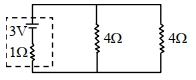
In the given circuit, the terminal potential difference of the cell is:
A particle moves along a parabolic path $y=9 x^2$ in such a way that the $x$ component of velocity remains constant and has a value $\frac{1}{3}\,m / s$. The acceleration of the particle is $.......m / s ^2$
Source and observer both start moving simultaneously from origin, one along $x-$axis and the other along $y-$axis with speed of source = twice the speed of observer. The graph between the apparent frequency observed by observer $f$ and time $t$ would approximately be :
Two identical charged spheres are suspended by strings of equal lengths. The strings make an angle of $30^o$ with each other. When suspended in a liquid of density $1\, g\, cm^{-3}$, the angle remains the same. If density of the material of the sphere is $4/3\, g\, cm^{-3}$, the dielectric constant of the liquid is
A potential difference of $42,000$ volts is used in an $X-$ ray tube to accelerate electrons. The maximum frequency of the $X-$ radiations produced is

$(1\,eV = 1.6 \times {10^{ - 19}}J$ and $h = 6.63 \times {10^{ - 34}}J - \sec )$
The ratio of wavelengths of the last line of Balmer series and the last line of Lyman series is
Maximum magnification produced by simple micro-scope of focal length $f=5 \,cm$ is
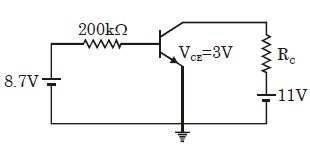
In the shown common emitter amplifier circuit, $\beta = 80$ , $V_{BE} = 0.7\,volt $ . The value of $R_C$ is 
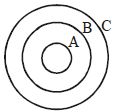
Charges $Q, 2Q$ and $-Q$ are given to three concentric conducting shells $A, B$ and $C$ respectively as shown the ratio of charges on inner and outer surfaces of shell $C$ will be