MCQ
The de-Broglie wavelength $\lambda$
  • A
    is proportional to mass
  • B
    is proportional to impulse
  • Inversely proportional to impulse
  • D
    does not depend on impulse

Answer

Correct option: C.
Inversely proportional to impulse
c
(c)The De-Broglie wavelength is $\lambda = \frac{h}{{|p|}} = \frac{h}{{|I|}}$$ \Rightarrow \lambda \propto \frac{1}{{|I|}}$

Need a full question paper?

Generate a complete, print-ready paper with questions like this in minutes — across 16+ boards, with answer keys.

Start Generating Free

Similar questions

For the sustained interference of light, the necessary condition is that the two sources should
The charge given to a hollow sphere of radius $10\, cm$ is $3.2×10^{-19}\, coulomb$. At a distance of $4\, cm$ from its centre, the electric potential will be
Three particles, each having a charge of $10\,\mu C$ are placed at the corners of an equilateral triangle of side $10\,cm$. The electrostatic potential energy of the system is.....$J$ (Given $\frac{1}{{4\pi {\varepsilon _0}}} = 9 \times {10^9}\,N - {m^2}/{C^2}$)
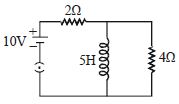
Current in $2\, \Omega$ resistance shown in figure is

$(a)$ Just after the closing of the key
$(b)$ Some time after the closing of the key
If energy of $15\, eV$ is given to electron in $4^{\text {th }}$ orbit then find it's final energy when it comes out of $H-$atom. (in $eV$)
Two point sources $P$ and $Q$ are $24\,cm $ apart. Where should a convex lens of focal length $9\, cm$ be placed in between them so that the images of both sources are formed at the same place?
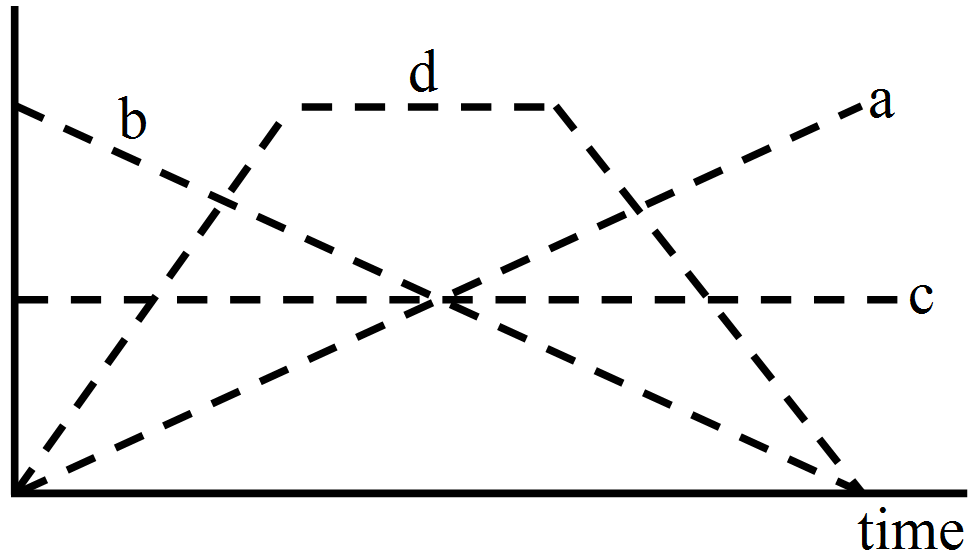
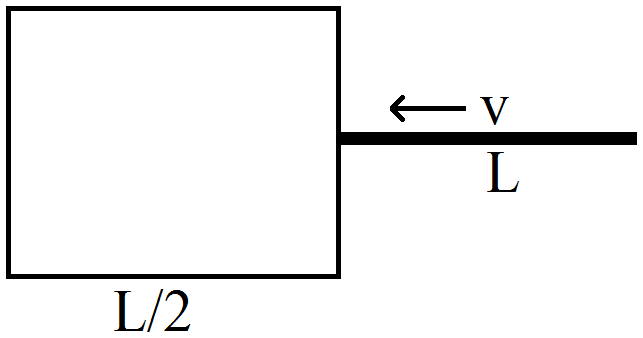
Figure shows an imaginary cube of edge $\frac{\text{L}}{2}.$ A uniformly charged rod of length $L$ moves towards left at a small but constant speed u. At $t = 0$, the left end just touches the centre of the face of the cube opposite it. Which of the graphs shown in figure represents the flux of the electric field through the cube as the rod goes through it?

The wavelength of the energy emitted when electron come from fourth orbit to second orbit in hydrogen is $20.397\,cm$. The wavelength of energy for the same transition in $H{e^ + }$ is .......... $c{m^{ - 1}}$
A beam of light strikes a glass plate at an angle of incident $60^o $ and reflected light is completely polarised than the refractive index of the plate is
Emf is most closely related to