MCQ
The decay of a proton to neutron is :
  • A
    not possible as proton mass is less than the neutron mass
  • possible only inside the nucleus
  • C
    not possible but neutron to proton conversion is possible
  • D
    always possible as it is associated only with $\beta^{+}$ decay
Answer

Correct option: B.
possible only inside the nucleus
b
It is possible only inside the nucleus and not otherwise.

Need a full question paper?

Generate a complete, print-ready paper with questions like this in minutes — across 16+ boards, with answer keys.

Start Generating Free

Similar questions

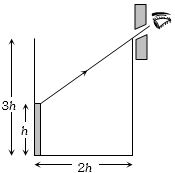
An observer can see through a pin-hole the top end of a thin rod of height $h,$ placed as shown in the figure. The beaker height is $3h$ and its radius $h$. When the beaker is filled with a liquid up to a height $2h$, he can see the lower end of the rod. Then the refractive index of the liquid is
Wavelength of light of frequency 100Hz
In the Young's double slit experiment, the intensity of light at a point on the screen where the path difference $\lambda$ is $K,$ ($\lambda$ being the wavelength of light used). The intensity at a point where the path difference is $\lambda /4$ will be
Time period of oscillation of a magnetic needle is
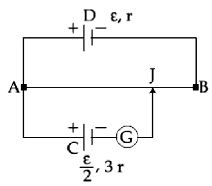
A potentiometer wire $AB$ having length $L$ and resistance $12\, r$ is joined to a cell $D$ of $emf$ $\varepsilon $ and internal resistance $r$. A cell $C$ having $emf$ $\varepsilon /2$ and internal resistance $3r$ is connected. The length $AJ$ at which the galvanometer as shown in figure shows no deflection is
If λ =10Å, then it corresponds to
A potentiometer is used for the comparison of $e.m.f.$ of two cells ${E_1}$ and ${E_2}$. For cell ${E_1}$ the no deflection point is obtained at $20\,cm$ and for ${E_2}$ the no deflection point is obtained at $30\,cm$. The ratio of their $e.m.f.$'s will be
A mass m = 20 g has a charge q = 30 mC. It moves with a velocity of 20 m/s and enters a region of electric field of 80 N/C in the same direction as the velocity of the mass. The velocity of the mass after 3 seconds in this region is
The stopping potential $({V_0})$
The energy of a hydrogen atom in its ground state is -13.6eV. The energy of the level corresponding to the quantum number n = 2 (first excited state) in the hydrogen atom is