MCQ
The decrease in the potential energy of a ball of mass $20 \,kg$ which falls from a height of $50 \,cm$ is ............ $\mathrm{J}$
  • A
    $968$
  • $98$
  • C
    $1980$
  • D
    None of these

Answer

Correct option: B.
$98$
b
(b)$\Delta U = mgh = 20 \times 9.8 \times 0.5 = 98\,J$

Need a full question paper?

Generate a complete, print-ready paper with questions like this in minutes — across 16+ boards, with answer keys.
Start Generating Free

Similar questions

In which one of the following regions of the electromagnetic spectrum will the vibrational motion of molecules give rise to absorption
Assume that the earth is a solid sphere of uniform density and a tunnel is dug along its diameter throughout the earth. It is found that when a particle is released in this tunnel, it executes a simple harmonic motion. The mass of the particle is $100 g$. The time period of the motion of the particle will be (approximately) (take $g =10\,ms ^{-2}$, radius of earth $=6400\,km$ )
A nucleus disintegrates into two nuclear parts, in such a way that ratio of their nuclear sizes is $1: 2^{1 / 3}$.Their respective speed have a ratio of $n: 1$. The value of $n$ is $.....$.
A metre scale is balanced on a knife edge at its centre. When two coins, each of mass $10\, g$ are put one on the top of the other at the $10.0\, cm$ mark the scale is found to be balanced at $40.0\, cm$ mark. The mass of the metre scale is found to be $x \times 10^{-2}$ $kg$. The value of $x$ is
The focal lengths of the objective and the eye-piece of a compound microscope are $2.0\, cm$ and $3.0 \,cm$ respectively. The distance between the objective and the eye-piece is $15.0 \,cm$. The final image formed by the eye-piece is at infinity. The two lenses are thin. The distances in $cm$ of the object and the image produced by the objective measured from the objective lens are respectively
The wavelength of Lyman series is
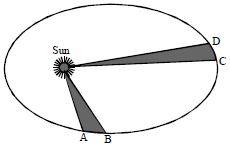
The fig. shows the motion of a planet around the un in an elliptical orbit with sun at the  focus. The shaded areas can be assumed to be equal. If $t_1$ and $t_2$ represent the  time taken for the planet to move from $A$ to $B$ and $C$ to $D$ respectively, then
Formation of bubble are in Column - $\mathrm{I}$ and pressure difference between them are given in Column - $\mathrm{II}$. Match them appropriately.
Column - $\mathrm{I}$ Column - $\mathrm{II}$
$(a)$ Liquid drop in air $(i)$ $\frac{{4T}}{R}$
$(b)$ Bubble of liquid in air $(ii)$ $\frac{{2T}}{R}$
  $(iii)$ $\frac{{2R}}{T}$
Two sound waves of slightly different frequencies have amplitude ratio $\frac{11}{9} .$ What is the difference of sound levels in decibels of maximum and minimum intensities heard at a point :- ............. $\mathrm{dB}$
A circular disc $A$ of radius $r$ is made from an iron plate of thickness $t$ and another circular disc $B$ of radius $4r$ is made from an iron plate of thickness $t/4$. The relation between the moments of inertia ${I_A}$ and ${I_B}$ is